Sensor + Test 2022

May 10
Vaisala Indigo520 with water droplets
Nürnberg Exhibition Centre
Nürnberg
Germany

Come and meet us at Sensor+Test 2022.

FoodTech 2022

Nov 01
Cookie production line
MCH Messecenter Herning
Vardevej 1, Herning
Denmark

FoodTech is Northern Europe’s largest food technology expo and a meeting place for the entire industry.

Automatik 2022

Sep 13
Automatation in semiconductor manufacturing
Brønby Hallen
Denmark

Welcome to experience AUTOMATIK 2022 - and gain new knowledge and inspiration. Vaisala's Danish distributors welcome you to their stand:

Sugar refinery boosts profitability with advanced sugar crystallization control

Sugar crystals
Industrial Measurements
Liquid Measurements
Thailand

​A sugar refinery in Thailand is benefiting from optimized batch vacuum crystallization strikes, crystal quality, and yield owning to the Vaisala K-PATENTS® SeedMaster SM-3. The refinery’s advanced process control solution was supplied and commissioned by Contrologic.

The ultimate aim of the automation project was to reduce the use of steam and water during the crystallization batch strikes while simultaneously improving sugar quality by keeping the crystal size distribution (CV) and mean aperture (MA) within tight specifications. This was achieved with a fully automated control strategy based on real-time supersaturation control.

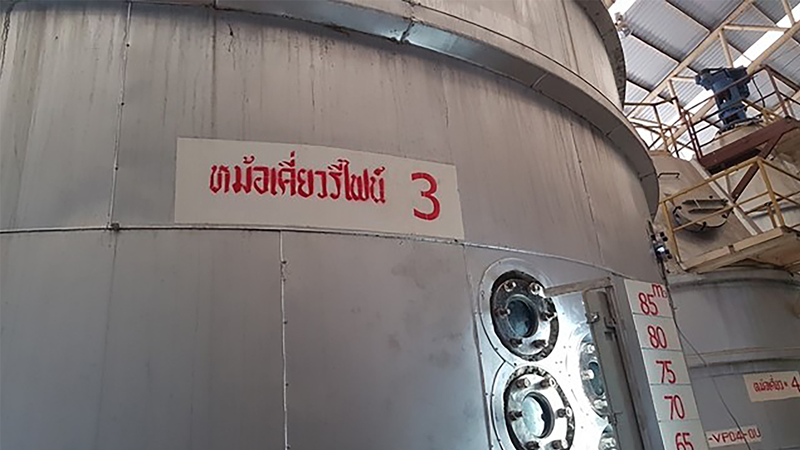
For instance, a comparison of the production yield, energy consumption, and crystal quality before and after implementation revealed that 7 m3 of water was used during a strike before, refinery pan volumes being 85 m3, see image 1 below.

Sugar pan in the refiner

Image 1. Sugar vacuum pan (85 m3).

Before the implementation water was used for eliminating new, unwanted fine crystals. Introducing the process control solution not only removed the need to use water, but also reduced steam consumption by about 25% while increasing yield by about 1%.


Sugar pan feed valves in the refinery

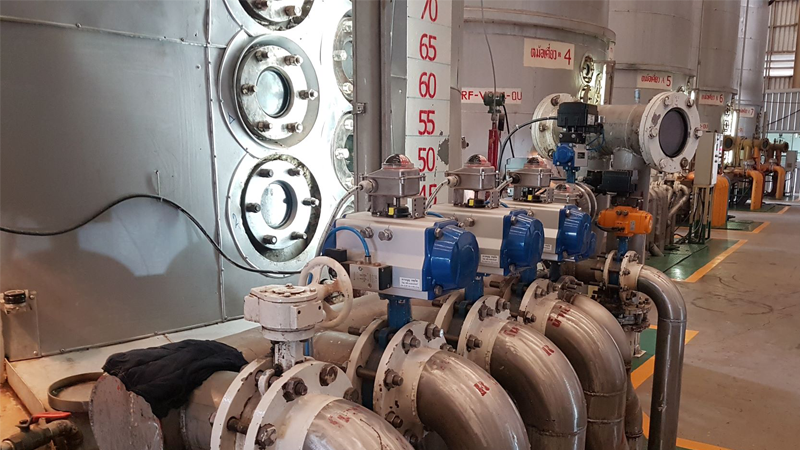
Image 2: Syrup feed valves.

Why supersaturation-based control?

Production of good-quality sugar relies on crystal growth, and supersaturation is the driving force for this growth. The speed of crystallization depends on this multivariable function of several parameters. Supersaturation is defined as the ratio of sugar in a solution to the sugar needed to saturate the solution at the same temperature.

Supersaturation has an optimal range where sugar crystals grow evenly and widely, reaching the desired crystal size. Outside this range the crystals will stop growing and may even melt or start to form new crystals spontaneously, creating fines and conglomerates that need to be reprocessed. This is a major problem as it wastes time and energy, increases production costs and water consumption, and decreases the effective yield of produced sugar.

To build supersaturation-based control that would eliminate these challenges, the pan was fitted with a Vaisala K-PATENTS® SeedMaster SM-3 system to provide real-time data for supersaturation calculation. The SeedMaster is specifically designed for sugar crystallization applications. The system consists of a process refractometer and multiparameter monitoring device that provides the parameters necessary for sugar crystallization and enables the implementation of a fully automated control solution.


Why customers choose the Vaisala SeedMaster

Improved product quality and consistency

The quality of the sugar is high, and the quality is consistent from batch to batch. With optimization, the amount of sucrose in the final molasses is reduced while the CV/MA is improved.

Substantial savings from optimizing raw material and steam consumption

Raw material consumption can be reduced, bringing operational savings, but the biggest saving comes from reduced steam consumption. Prior to implementing an automated control strategy using the SeedMaster, the Thai sugar refinery was consuming 39.4 tons of steam per strike; after implementation steam consumption fell to 29.5 tons per strike.   

There is also a cumulative effect, as each step in the sugar production process requires water. Sugar factories generate the steam used for processing and sell the surplus as electricity to the grid. Controlling and optimizing the production process will allow factories to sell more power to the grid.

Less reprocessing of false crystals

When the sugar crystals are of a consistent size it reduces the time and cost associated with reprocessing false crystals.

Fewer labor-intensive tasks

The SeedMaster SM-3 automates supersaturation control, meaning production staff no longer need to spend time on sampling and other manual tasks.

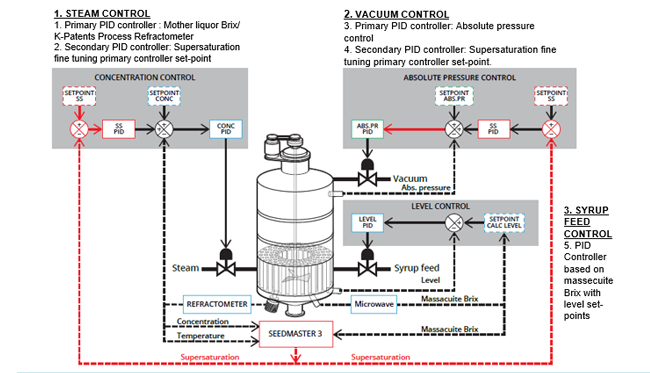
Process control requires the following:

  • Concentration control using a digital inline process refractometer
  • Absolute pressure control
  • Level control
  • Microwave density meter


Three control levels for instruments and PID controllers

3 control levels for instruments and PID controllers


Would you like to know more?

Accurate process control brings huge advantages to refineries crystalizing sugar. A supersaturation-based control strategy using process refractometers can be used to optimize crystallization, including yield, quality, and energy efficiency.

PDF

Contact us for more information.

Virtual Achema Pulse 2021

Jun 15
Factory pipes
Virtual

Join Vaisala in virtual Achema Pulse event for the global ACHEMA community on June 15 - 16. Come and exchange ideas on the latest trends in the chemical, pharmaceutical, biotech and food manufacturing, and energy and environmental industries.

Virtual pre-Pulpaper 2021

Apr 29
Paper rolls
Virtual

PulPaper is the leading international event in chemistry, process industry and wood processing industries bringing together the key operators. At Virtual pre-PulPaper decision-makers and professionals as well as the most significant companies


Why Vaisala is a preferred vendor for many semiconductor fabrication plants for qualifying H2O2 concentration in CMP of tungsten

Semiconductor wafers
Industrial Measurements
Liquid Measurements
Semiconductor fabrication

PDF version 

Chemical mechanical planarization/polishing (CMP) is a critical, very costly, and challenging nano-polishing process that combines chemical reactions and mechanical abrasion. It is the key enabling step in integrated circuits manufacturing, affecting both yield and productivity.

CMP in a nutshell

Polishing is done with a slurry that includes an oxidizing agent, typically hydrogen peroxide (H2O2). During manufacturing, a wafer is pressed against a polishing pad while both wafer and pad are rotated counterclockwise at slightly different velocities. As slurry is dispensed on the center of the pad, the combination of mechanical and chemical actions gradually removes material from the wafer surface, leading to a surface that is locally and globally planar. 

CMP slurries are mixed or diluted at the plant before use. Oxide polishing slurries are commonly purchased in concentrated form and diluted with water on-site to minimize shipping and labor costs. Some multicomponent polishing slurries may only be blended immediately prior to their use because of their short post-mix lifespan. The correct blend is essential as it is directly linked to chemical reaction rates and the wafer polishing rate; any defects in the blend have a negative impact on manufacturability and reliability. Although the slurry control at the point of manufacture (POM) is tight, subsequent processes – including transportation, handling, and filtration – can affect the chemical properties, and therefore continuous slurry monitoring is required until point of use (POU) to ensure high yield. Effective, rapid, reliable, precise, and cost-effective metrology tools and methodologies are required, so many fabrication plants choose to use refractometers.

How refractive index helps to improve production quality

Refractive index (RI) – a continuous, in-line, non-slurry-consuming measurement – helps fabrication plants identify slurry composition faults quickly as it conveys real-time information about the process, reducing the number of wafers at risk.

CMP slurry carries nanoparticles to solids content levels of 1–30% depending on the slurry type, making it challenging to analyze. However, once calibrated to a specific slurry’s temperature/RI characteristics, RI measurements can successfully determine the concentration of hydrogen peroxide in tungsten slurry to within ±0.03% by weight even in these difficult conditions.

Moreover, unlike conductivity probe tests, RI measurements can monitor H2Oslurry density, an indicator of settling and degradation of the slurry over time. Therefore, the RI is used not only to qualify the final product but also to monitor batch-to-batch variations in the incoming raw slurry and to validate the blend-addition steps.

An attractive feature of some slurry delivery systems has been the ability to use an automated chemical-spiking function in the day tank.

Inline refractive index vs. online titration of H2O2 in slurry conc%
Inline refractive index vs. online titration of hydrogen peroxide in slurry conc%

Vaisala K-PATENTS® Semicon Refractometer benefits

The Vaisala K‑PATENTS Semicon Refractometer is specifically designed for semiconductor manufacturing environments. It has a small footprint and the construction is metal-free, making it ideal for measuring chemicals without corroding the process.

The Vaisala K‑PATENTS Semicon Refractometer is the superior choice for CMP operations because:

  • Measurement is fully digital, and drift is impossible
  • The integrated temperature measurement component ensures highly accurate RI measurement
  • It offers direct density measurement
  • The robust design tolerates process vibrations with no measurement errors
  • Built-in diagnostics give an instant overview of process conditions
  • Of the availability of different high-quality flow cells, that are designed to reduce and even eliminate fouling.

References

Diversified Fluid Solutions has been using the Vaisala K-PATENTS Semicon Refractometer successfully for years in its CMP operations and has found the device extremely reliable and accurate. “As advanced process nodes bring increasing numbers of CMP steps, we must ensure that the slurries delivered to the polishing tools maintain consistent chemical and mechanical characteristics,” explains Karl Urquhart, Director of R&D, Chemical Technology, Diversified Fluid Solutions. “Inline RI monitoring can evaluate the chemical composition of incoming material, qualify blend addition steps, and validate a uniform CMP slurry blend in a single real-time, non-slurry-consuming measurement.”

The first H2Omeasurement installation for CMP slurry was installed at a large semiconductor fabrication plant in 2013, replacing auto-titration. The measurement device has remained stable ever since, with no instrument maintenance required beyond routine flushing of the slurry blender.

In general, after installing a Vaisala K-PATENTS Semicon Refractometer the wafer throughput at fabrication plants increases by approximately 20%. In addition, CMP slurries are strictly controlled and enable improved uniformity of the planarization process.

Would you like to know more?

RI measurement is a simple, cost-effective, and accurate technique that provides real-time information on slurry composition, making a refractometer the metrology instrument of choice for many fabrication plants.

Contact us for more information.

Something special for this Valentine’s?

Pralines filling
Industrial Measurements
Liquid Measurements

PDF

Producing mind-blowing confectionery

There are different Valentine's day traditions around the world: some write love poems to their beloved, other celebrate it as a friendship day. However, one of the most popular traditions is to exchange chocolates as a message of affection. 

Why is chocolate associated with love? The secret lies in neurological connections of the brain. The mouthfeel, fat, sugar and cocoa, and appealing appearance are the feel-good components that trigger the feeling of happiness in us through the dopamine release in our brain. In this article, we won’t go deep into the neuroscience but, rather, discuss what it takes to produce high-quality confectionery.   

“Life is like a box of chocolates – you never know what you’re going to get”...

…but when it comes to making chocolate fillings, process controllers demand much higher levels of confidence. This can be achieved with the latest technology, the in-line refractometers from Vaisala, which are used at various points in the process, providing continuous measurements of Total Solids (TS) or Brix (dissolved solids) for consistent product quality control. 

In-line Refractive Index (RI) monitoring with automatic feedback control and alarms when measurements approach warning levels, enables process operators to ensure a consistent and reliable product, so that ongoing production complies not only with our taste buds, but also with the manufacturing regulations and product specifications. 

Quality above everything

One of Vaisala’s chocolate manufacturer customers has the slogan ‘Quality Above Everything,’ so it is hardly surprising that the company has invested in Vaisala K-PATENTS® Sanitary Refractometers to continuously monitor Brix for final quality control.
The pralines contain cherries soaked in a cherry brandy liqueur and covered in a rich, dark chocolate coating. 

The chocolate maker uses Vaisala refractometers for the quality control of the liqueur; checking that production adheres closely to the recipe. Ethanol is added to the brandy to meet the correct liqueur concentration, and Brix measurements are taken immediately prior to the addition of the brandy to the cherries.

Production areas containing products with a high level of alcohol are considered as hazardous ATEX zone 2 areas. So, in addition to the monitoring device being approved for sanitary applications, it must also have an ATEX classification. In this particular example case, it was necessary for the refractometer to be intrinsically safe and compliant with the requirements of ATEX Zone 0/1. Vaisala’s solution therefore combined both 3-A and EHEDG + ATEX zone 2, 1 or 0.

Prior to the installation of the Vaisala refractometers, testing was undertaken by manually sampling for laboratory analysis. This was costly and time-consuming; incurring a delay in the provision of test results. Any deviation from specification could therefore result in the loss or wastage of product, but with the benefit of inline monitoring, issues are detected immediately so that appropriate measures can be undertaken without delay.

The food of the gods

Cocoa powder is the most important ingredient in the preparation of chocolate sweets. It is produced by processing the cocoa beans from cacao trees, known as Theobroma cacao, in Greek "the food of the gods".

There are two types of cocoa powder. Natural cocoa powder, which is brown and naturally acidic (pH 5 - 6), and dutched cocoa powder which is made from cacao beans that have been washed with an alkaline solution to neutralize their acidity. The rich chocolate color and taste qualities of dutched cocoa powder are affected by the type and concentration of the alkali, so Vaisala K-PATENTS process refractometers are employed to ensure that the process operates within tightly defined concentration limits or specifications.

You can learn more from the application note.

Quality control in confectionery production

Sugar confections and chocolate fillings are produced by preparing a diluted mixture of the ingredients, and then concentrating the sugar content to the desired level by cooking and evaporating the water. The final Brix of the mixture determines the flavor, consistency, and overall quality of the final product. Careful monitoring is therefore necessary in order to ensure consistent, reliable product quality.

Incorrect moisture content can harm the physical characteristics of the final product; causing processing problems upstream and affecting final product quality. Excessive moisture can also cause product deterioration by promoting the growth of microorganisms.

The Vaisala K-PATENTS Sanitary Refractometer continuously measures the Brix level of the cooking solution. This provides real-time information to determine the end-point of cooking, and to ensure consistent product quality. Read more in the application note.

Robust technology and reliable measurement of Vaisala K-PATENTS process refractometer stand for unprecedented quality of the products we love. Your Valentine’s day is saved – your favorite pralines taste just as good as always!

One technology; multiple applications

In contrast with many other liquid concentration methods, the Vaisala K-PATENTS refractometer is not affected by particles, bubbles, crystals or color, so these instruments can be employed in a wide variety of solutions for measuring liquid concentration. Importantly, the Vaisala K-PATENTS refractometers are 3-A Sanitary Standards and EHEDG certified. In addition to the confectionery industry, Vaisala’s refractometers are commonly employed in many different food and beverage applications as well as other industries such as semiconductor, chemical and refining, pulp and paper, textiles and pharmaceutical. Discover our full offering here.
 

Related products
The power of in-line Brix- eBook

The power of inline Brix

The eBook provides insights into such critical tasks of food and beverage production as food safety, cost savings, sustainability and resource efficiency and while maintaining the highest product quality. These and other important tasks can be achieved by measuring Brix inline. Discover more by downloading the eBook.

Add new comment