Expert article
Why choose Dew point/Frost Point Temperature over Relative Humidity or PPM measurements in ultra-dry conditions?



In ultra-dry environments, selecting the right measurement parameter is critical for process efficiency and product quality. While relative humidity (RH) sensors perform adequately at moderate humidity levels, their reliability diminishes rapidly as conditions become drier.
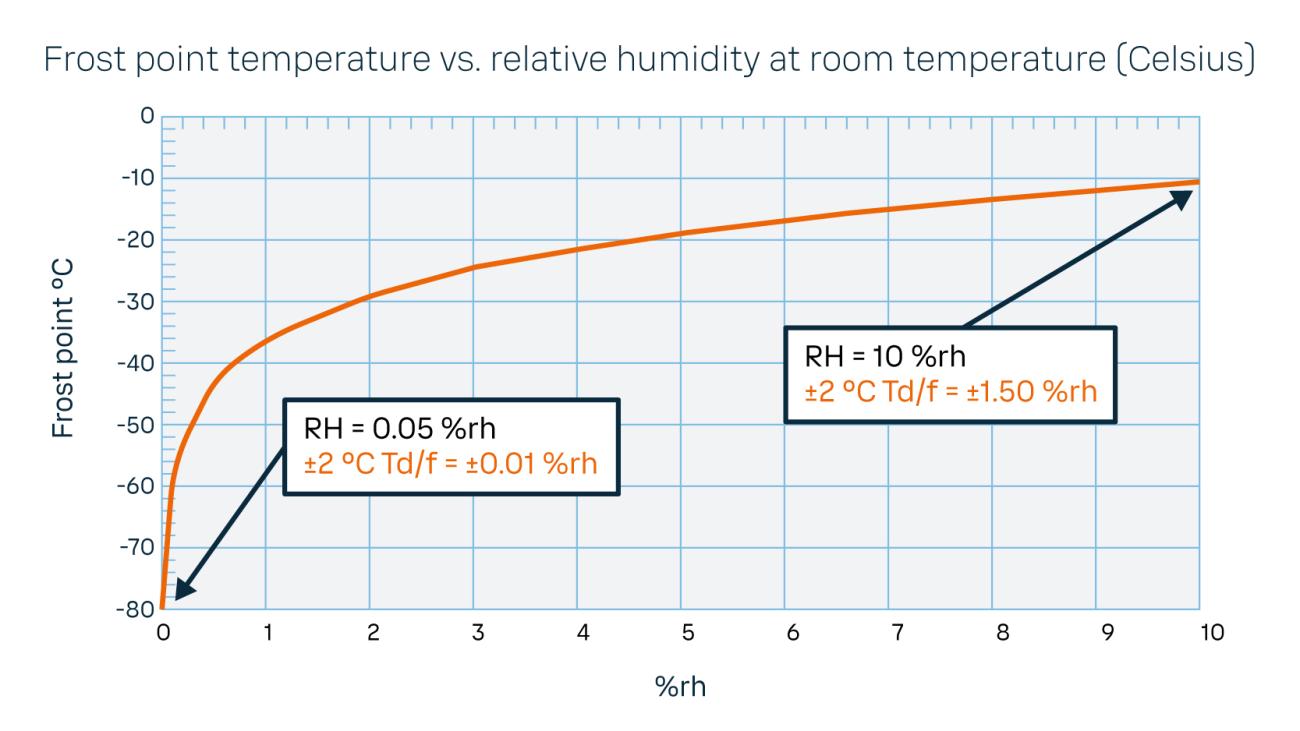
Why dew point sensors outperform relative humidity in ultra-dry environments?
This is due to the non-linear relationship between dew point and RH: at RH below 5%, measurement uncertainty increases significantly, and below 1%, accurate RH measurement becomes nearly impossible.
In contrast, Vaisala’s dew point and frost point measurements maintain high accuracy and resolution even at extremely low moisture levels, supporting energy efficiency and product quality, making them the preferred choice for demanding applications such as battery dry rooms, semiconductor manufacturing, and industrial drying processes.
Dew point vs. frost point: What’s the difference for industrial applications?
- Dew point: Temperature where water vapor condenses as liquid water.
- Frost point: Temperature where water vapor forms frost or ice.
It is important to appreciate the fact that dew point is not the same as frost point. This is because dew point involves condensation (gas to liquid), whereas frost point involves a different phase change - deposition (gas to solid). The terms “dew point” and “frost point” are sometimes used inconsistently or without clear specification in industrial settings, which introduces ambiguity and measurement challenges because the frost point values and the theoretical dew point values which describe the same trace moisture condition are significantly different.
For sub-zero measurements, ‘frost point’ is the correct term, reflecting the phase change from gas directly to solid.
Are PPM measurements ideal for ultra-dry conditions?
In short: Not without specialized equipment.
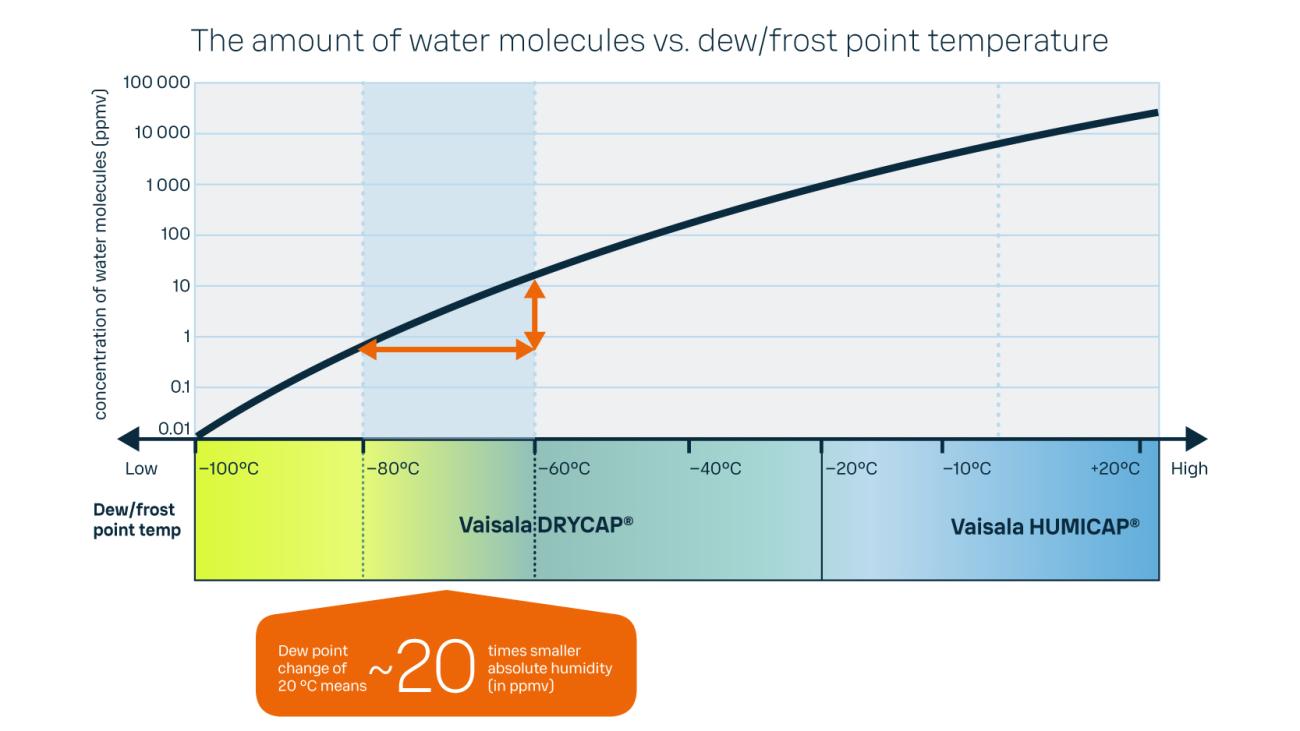
Water concentration measurements in ppm are less suited to ultra-dry conditions because they are unable to retain accuracy and precision at such low levels, especially as frost point drops below -60°C.
A move from -60°C to -80°C frost point, the absolute humidity in ppm reduces twenty-fold, which would be challenging to measure accurately in ppm. This limitation underscores the importance of using dew point or frost point sensors specifically engineered for low-humidity environments.
Selecting the right Vaisala sensor technology for ultra-dry conditions
Vaisala offers two sensor families optimized for different humidity ranges. HUMICAP® sensors are designed for broad RH measurement (0–100 %rh), while DRYCAP® sensors excel in ultra-dry conditions (0–10 %rh) and low dew and frost points.
DRYCAP® technology incorporates advanced features such as auto-calibration and thin-film polymer capacitive sensing, ensuring stability and reliability in applications like compressed air systems, battery manufacturing, and semiconductor production.
How Vaisala eliminates challenges associated with high-precision analytical equipment
While laboratory analyzers can deliver exceptional accuracy if diligently maintained and used only in stable laboratory conditions, their use in industrial environments is often impractical. Sample lines necessary to use laboratory instruments for industrial applications introduce risks of leaks, contamination, including moisture, temperature-induced fluctuations, and delayed response times.
Installing fast-response sensors which are reliable in a variety of industrial conditions directly at critical measurement points mitigates these challenges and ensures real-time, actionable data.
Choose the right Vaisala sensor for your application
For robust, accurate measurements in ultra-dry environments, Vaisala recommends:
DMT143: Wide measurement range from -70 °C to +60 °C frost/dew point (DRYCAP®)
DMT152: Specialized for ultra-dry conditions, measuring from < -80 °C to -20 °C frost/dew point (DRYCAP®)
Resources
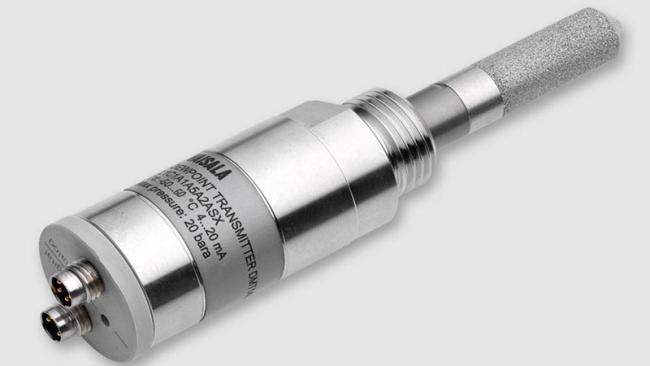
Dew Point Transmitter DMT143
For a wide measurement range –70 °C to +60 °C frost/dew point (DRYCAP®)
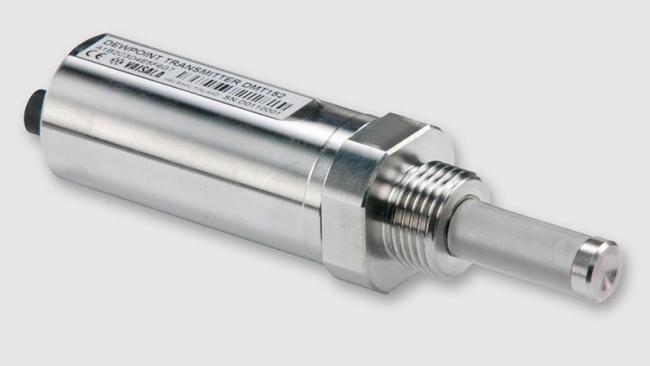
Dew Point Transmitter DMT152
For ultra-dry conditions from < -80 °C to -20 °C frost point (DRYCAP®)