Expert article
Cybersecure weather intelligence for offshore operations




Offshore operations are undergoing a profound transformation. Assets are more connected than ever, data flows freely between platforms, vessels and shore, and software increasingly sits at the heart of safety‑critical decision‑making. In this environment, cybersecurity is no longer just an IT concern; it is integral to operational safety.
With the new Vaisala Maritime Automatic Weather Station AWS830, our goal was to respond directly to this reality. We combined decades of experience in demanding maritime weather measurement with a modern cybersecure architecture, purpose-built for helidecks, offshore energy and naval operations.
Why cybersecure weather intelligence is now essential
In recent years, cybercrime has grown significantly. Maritime operators are high‑value targets, and some well‑known attacks have resulted in hundreds of millions in damages and full IT infrastructure rebuilds. At the same time, regulations for helideck and met‑ocean systems, such as UK CAA CAP437, have tightened, while operators demand more data, more connectivity and more automation and AI.
When weather and helideck monitoring systems are integrated into navigation, aviation and operational decision‑making, they must themselves be secure by design. Data quality, data integrity and cybersecurity are now inseparable.
This was the starting point for AWS830.
Introducing Maritime Automatic Weather Station AWS830
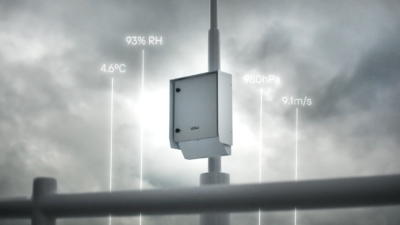
AWS830 is Vaisala’s latest maritime automatic weather station. It is intended for specialized ships and research vessels, offshore wind and oil and gas platforms, offshore substations and naval vessels – in practice, any asset where high‑quality real‑time weather and helideck information is critical.
The system builds on more than a decade of field experience with its predecessor, Automatic Weather Station AWS430. That platform has operated reliably on vessels and offshore structures worldwide, from polar icebreakers in minus 50°C conditions to high‑humidity equatorial environments. With AWS830, we wanted to retain that robustness, but redesign the core around modern cybersecurity and modularity.
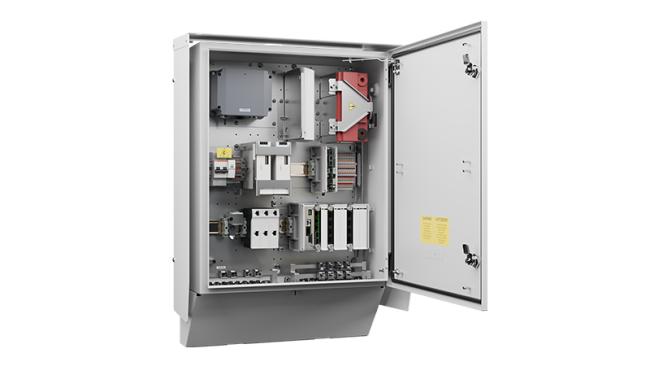
The station is available both as a robust outdoor unit for exposed environments and as a 19‑inch rack‑mounted version for equipment rooms. It supports a wide range of Vaisala and third‑party sensors, including the full meteorological suite, met‑ocean sensors, and optional vertical wind lidar integration to provide wind profiles hundreds of meters above helidecks. In a typical configuration, AWS830 acts as the central data management unit, collecting and validating inputs from all these sensors and feeding them securely into Vaisala Elements Helideck Monitoring Software.
Built-in security
From the outset, we approached AWS830 as a security appliance as much as a data logger. Cybersecurity is implemented through defense in depth, covering hardware, software, communications and lifecycle.
At the device level, secure boot ensures that only Vaisala‑signed firmware and software images can run on the system. This protects against both malicious and unintended software changes. During operation, runtime integrity mechanisms prevent modification of the running image. We have also eliminated hard‑coded passwords, a long‑standing weakness in many embedded systems.
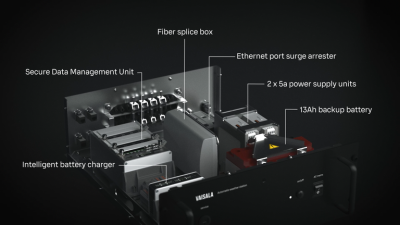
Data security is equally central. Communication from the logger to the rest of the system uses industry‑standard encrypted interfaces, such as SFTP (Secure File Transfer Protocol) and REST (Representational State Transfer) APIs over TLS (Transport Layer Security). The connection between AWS830 and Vaisala Elements Helideck Monitoring Software is both certificate‑based and TLS‑secured, which protects against man‑in‑the‑middle attacks and ensures that data streams remain confidential and trusted even on shared or complex networks. From Elements running offshore to Elements Online in the cloud, data is again transported over HTTPS/TLS.
Network‑level resilience is addressed through a built‑in, configurable firewall on the data logger. This allows operators and integrators to restrict exposed services and reduce attack surface according to their own network design. During development, AWS830 was tested against denial‑of‑service scenarios and network storms to verify that it remains stable under stress.
Equally important is how the product is developed and maintained. AWS830 follows a secure development lifecycle aligned with IEC 62443 principles, including threat modelling, systematic security testing and rigorous code reviews. Looking ahead, support for encrypted and signed remote software updates means the system can be kept current throughout its life, rather than gradually drifting out of date as new vulnerabilities emerge.
Taken together, these measures represent a shift from “weather station as peripheral device” to “weather station as secured, central component of the OT network”.
Applying zero‑trust principles offshore
The cyber model behind AWS830 is rooted in zero‑trust thinking. We no longer assume that devices or networks are trustworthy by default. Instead, every interface must authenticate, and all critical traffic must be encrypted.
In practice, this means the connection from sensors, through the logger, to Elements is treated as untrusted until explicitly secured. Certificate‑based authentication replaces simple IP‑based trust or shared passwords. Even if a network segment is compromised or misconfigured, the attacker should not be able to tamper with the data stream or inject unauthorized code into the system.
This approach is particularly relevant given the complexity of modern supply chains. Offshore systems often combine sensors and components from multiple vendors, sourced globally. A secure, vertically integrated platform around AWS830 and Elements helps operators regain control of this environment.
End‑to‑end architecture with Elements software
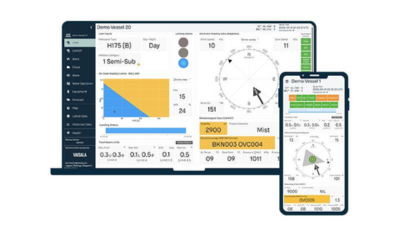
AWS830 is designed to work in combination with Vaisala Elements Helideck Monitoring Software. Together they form an end‑to‑end architecture for weather and helideck intelligence.
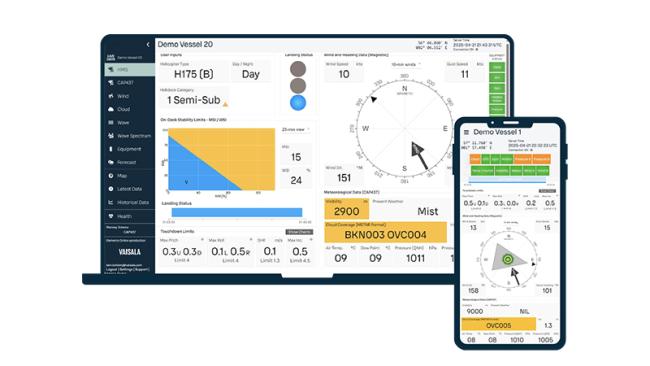
Elements Offshore runs on‑premises on the platform, vessel or substation. It receives encrypted data from AWS830, processes it to meet CAP437 and other regulatory requirements, and presents real‑time aviation‑style displays for radio operators, helideck officers, marine controllers and crane operators. Standard views show wind, visibility, cloud, sea state and helideck status in familiar layouts. Additional views and time‑series tools allow operators to drill into specific parameters when needed.
Cybersecurity is built into Elements as well. Access is controlled by usernames and passwords or single sign‑on, depending on the customer environment. Role‑based access control ensures that users only see the stations and data they are entitled to. Data is encrypted both in transit and at rest. Our software development process includes threat modelling, robust testing and regular security patches, including updates to third‑party dependencies.
Elements Online is an optional cloud component that extends this architecture to a global audience. It receives secure feeds from Elements Offshore and distributes real‑time and historical data to controlled users in offices, to contractors and to nearby vessels, all through a browser‑based interface. Elements Online also connects to Vaisala Xweather services, enabling global lightning observations and high‑resolution forecasts. Operators can view thunderstorms approaching within a 100‑kilometre radius and see 15‑day forecast time series and map layers for each asset.
The offline and online versions of Elements share the same user interface, which simplifies training and adoption. Whether a user is sitting in a radio room offshore or in an operations center onshore, they see the same displays and rules.
Modularity for evolving needs
While cybersecurity was one of the two main design pillars for AWS830, modularity was the other. Offshore operators rarely want a monolithic, fixed‑function system that cannot evolve. Instead, they prefer a platform that can start with a basic configuration and grow with changing operational needs.
AWS830 supports exactly this approach. It can be configured as a straightforward maritime weather station, a CAP437‑compliant helideck monitoring system, or a broader offshore weather awareness system with additional met‑ocean sensors, wind lidars and advanced services, like lightning detection and weather forecasts via Elements Online. Operators can add sensors and capabilities over time without replacing the core.
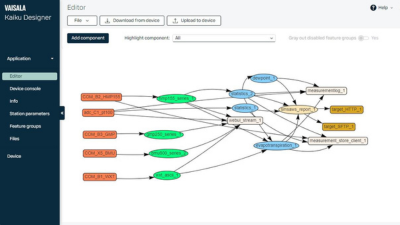
To make this manageable, we developed Kaiku Designer, a visual configuration tool for the data logger. It provides a graphical view of data flows from sensors to processing blocks and onward to outputs and destinations. What you see on the screen is what the system will do, which reduces configuration errors and speeds up commissioning. For advanced users, Kaiku provides a Python extension capability, allowing custom algorithms to be implemented using a widely known programming language. This means the knowledge and application logic developed by the customer stays with the system and can be adapted over time.
The result is a platform that is not only robust and secure today, but also adaptable to new standards, new sensors and new operational models tomorrow.
The new baseline for cybersecure maritime weather intelligence
With AWS830, we wanted to redefine what a maritime weather station is. It is no longer just a collection of sensors reporting to a black box. It is a cybersecure, modular, vertically integrated weather intelligence platform.
For offshore wind farms, oil and gas platforms, naval vessels, research ships, icebreakers and any asset with a helideck in demanding environments, AWS830 delivers high‑quality measurements, regulatory compliance and security by design. Combined with Elements software, it offers a complete, end‑to‑end solution that supports safer, smarter and more sustainable operations. AWS830 has DNV Type Approval according to IEC 60945 Ed. 4 for maritime navigation and radiocommunication equipment.
In a world where cyber threats are growing and data is at the core of every decision, cybersecure weather intelligence is not optional. It is the new baseline.
Related products
Resources
Webinar: Cybersecure offshore weather intelligence for safer helideck & met-ocean operations
See how AWS830 improves safety, reliability and decision making for offshore wind, oil & gas, naval and research operations.
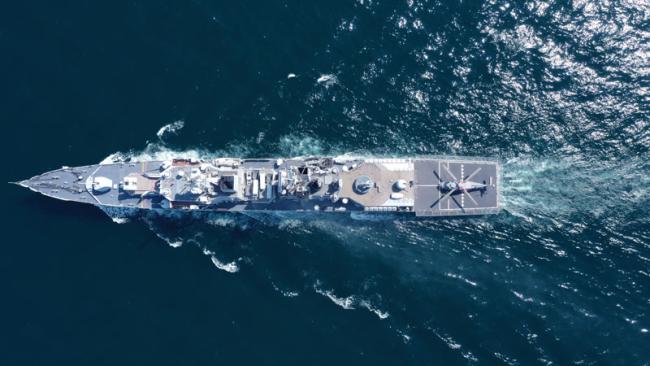
Maritime Observation System AWS830 for naval defense
Rely on excellent performance no matter what the weather brings: AWS830 is designed for critical maritime applications.