Why undisturbed wind measurement is the key to unlocking wind-assisted vessels maximum power performance
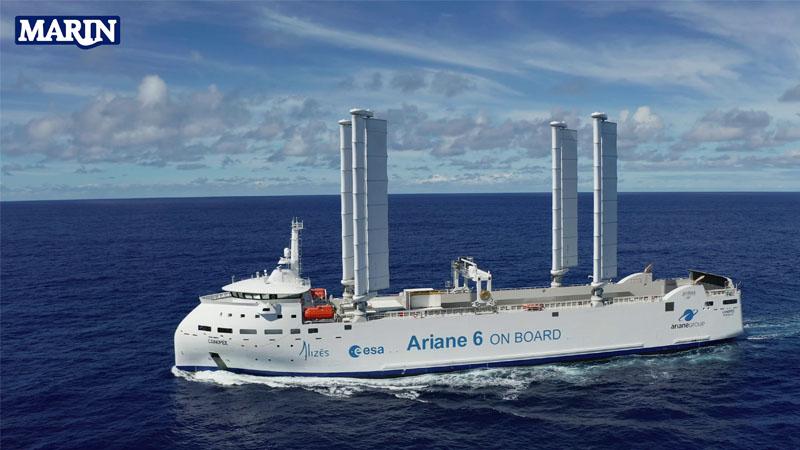

The wind-assisted ship propulsion (WASP) market is entering an exciting phase of rapid growth. According to International Windship Association (IWSA) WASP market is expanding rapidly, with over 60 large-vessel installations and 100 more on order for delivery by 2026, while the small-vessel fleet has nearly doubled in the past year. By 2030, IWSA projects between 3,700 and 10,700 systems could be installed globally—evidence of strong momentum across all vessel segments. From rotor sails to hard and soft wings, suction sails, and kites, a diverse range of technologies is being deployed on vessels worldwide. Shipowners, technology providers, shipyards, and classification societies all see the potential of wind propulsion as a key contributor to decarbonizing shipping.
But while adoption is accelerating, the next frontier is clear: ensuring that these systems deliver even further optimized power performance. The key lies in environmental conditions, and especially one factor —accurate measurement of undisturbed wind conditions, enabled by lidar-based remote wind monitoring.
Survey insights reveal a clear market shift
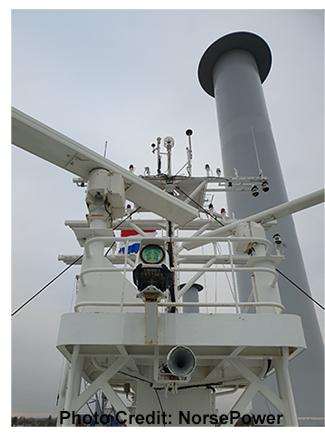
Vaisala’s 2024 survey on wind observation and optimization highlights just how much industry perspectives have shifted.
In 2022, only 20% of survey respondents considered local wind measurements “very important.” By 2024, that number had surged to 75%, showing how quickly industry priorities have shifted. Today, 87% of respondents say local wind data is essential for optimizing wind propulsion systems, and half report that it also improves safety. At the same time, nearly 70% now favor lidar-based remote wind measurements, which capture undisturbed upstream conditions and enable predictive adjustments for even greater efficiency.
The results send a strong message: wind data has become the number one challenge—and undisturbed wind data on the other hand the priority for WASP optimization.
From navigation to propulsion input
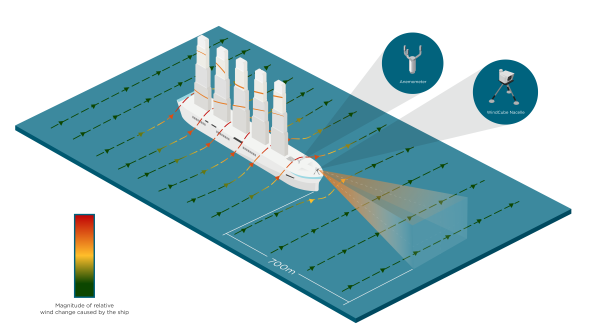
On conventional vessels, wind data has typically been used for navigation and safety. For WASP-enabled ships, however, its role is far more critical. Here, wind data isn’t just an environmental parameter—it is a direct input into the propulsion system, the power itself.
That means inaccuracies caused by turbulence, flow interference, or poor sensor placement can compromise maximum efficiency of wind propulsion thrust and safety. In WASP vessels, undisturbed wind measurement is not optional—it is fundamental to achieve maximum performance and fuel savings.
Cost of inaccurate wind data
In 2023, Vaisala conducted study, based on the research “Design operation and analysis of wind-assisted cargo ships” by Fabian Tillig, Jonas W. Ringsberg, to quantify the impact of wind measurement accuracy on propulsion efficiency. The study compared lidar data with conventional anemometer data across two vessel types—a tanker and a RoRo—equipped with Flettner rotors.
- Route A (anemometer, inaccurate wind angle 20°): 26% fuel reduction.
- Route B (lidar, accurate wind angle 25°): 28.6% fuel reduction.
In other words, correcting just a 5° error in wind angle with lidar translated to an additional 2.6% fuel savings.
These findings show that lidar-based undisturbed wind measurement can unlock significant operational and financial benefits.
From optimization to investment credibility
For shipowners, the importance of undisturbed wind data extends beyond day-to-day operations. It is also critical for performance validation and financial credibility.
As more financiers back wind propulsion projects, the ability to provide reliable and validated savings data becomes essential. For example, Union Maritime recently secured $130 million in financing for wind-assisted newbuilds, underlining that capital is increasingly flowing toward WASP projects with credible performance potential.
By ensuring undisturbed wind measurement through lidar, operators can strengthen the credibility of WASP savings claims—a decisive factor in attracting investment and scaling adoption.
Industry alignment
This shift toward undisturbed wind measurement is also reflected in regulatory and industry standards:
- The new ISO 15016:2025 specifications for the assessment of speed and power performance by analysis of speed trial data, which will be applied to sea trials conducted in 2026, explicitly recognizes lidar as a valuable and trustable tool for obtaining accurate wind data in sea trials.
- For the best accuracy for wind measurements DNV recommends the use of lidar to improve WASP-vessel performance verification and system optimization. Read more from our interview with DNV on “Maximizing wind-assisted ship performance verification with wind lidar”.
- MARIN’s (Maritime Research Institute Netherlands) four-year revision process incorporated a decade of STA and ITTC research, improving wind correction methods and introducing new wind limits. With the adoption of lidar for undisturbed wind measurement, higher wind speeds are now permitted. Read more here.
These developments confirm that lidar is moving from an emerging technology to a recognized standard for credible wind-assisted performance.
WASP ROI with the speed of wind
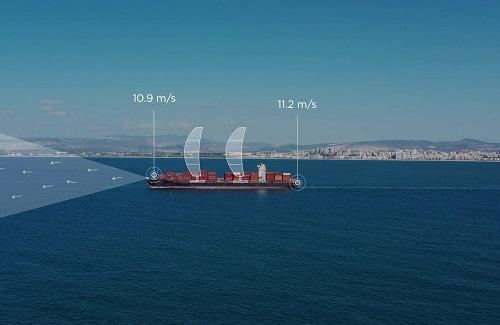
As the wind assisted vessel market matures, success will not be defined by technology adoption alone, but by how effectively vessels harness and optimize the wind.
Undisturbed wind measurement is essential for credible optimization and lidar solutions provide accuracy that conventional wind sensors cannot achieve.
Verified performance strengthens the case for investment and accelerates decarbonization. At Vaisala, we are proud to support this transition with advanced wind sensing technologies, including wind lidars, to ensure that undisturbed wind data drives undisturbed progress for the WASP industry.
Learn more from this topic from our upcoming webinar “Optimizing wind-assisted vessel performance through accurate wind measurements”, September 30th 2025, together with DNV and Norsepower.


