Application note
Integrated weather data for efficient building operation



Improving performance
Sustainability is a key performance goal for the modern built environment, which sees continual development of the tools to improve energy efficiency and mechanical system performance by using measurement data. Efficient building automation systems (BAS) monitor and manage the energy use and occupant comfort within a building. They use an array of sensors and inputs to balance and maintain performance of the HVAC equipment.
The weather conditions are some of the primary influences on the indoor environment that require energy to control and condition. Building Information Modeling (BIM), digital twins, and advanced BAS can use real-time weather data to improve system strategies that make the building more efficient to operate, as well as a more comfortable and productive indoor environment. When forecast and real-time weather data are integrated into a BAS, it can increase the efficiency of HVAC, reduce use of the municipal water supply, and other resources. It is critical that this weather data be accurate, reliable, and simple to integrate into the systems that analyze and make control decisions.
Practically maintenance-free with no moving parts, the WXT536 incorporates unique Vaisala solid state sensor technology, including: the WINDCAP® ultrasonic wind sensor, the RAINCAP® piezoelectric rain detector for added robustness, the incredibly stable BAROCAP® barometric pressure sensor, and the industry leading HUMICAP® humidity sensor for the harshest conditions. The WXT536’s optional heating can be used in the coldest climates to ensure performance, and a variety of mounting and bird deterrent accessories are also available.
With the WXT536 it is possible to output several parameters from one instrument instead of installing a separate instrument for each parameter. The WXT536 provides a flexible solution to integrate the different variables and ranges used by advanced systems.
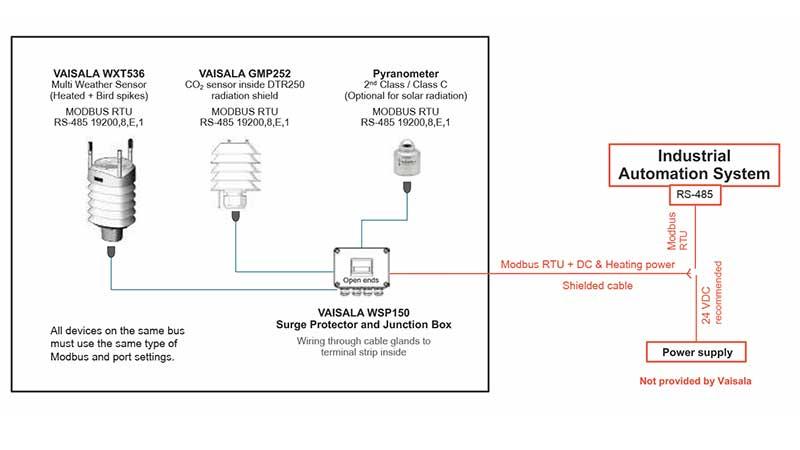
Modbus integration
For easy integration into the majority of contemporary controllers, systems, and IoT networks, the WXT536 is available with the Modbus RTU industrial serial protocol. Vaisala transmitters with RS-485 and Modbus can connect directly to a standard Modbus fieldbus among any other sensors. Because Modbus has been globally available since its beginning, most control system manufactures have support for it, at least as a secondary protocol in addition to their own primary protocol.
With flexible configuration options and tools, the Modbus output can calculate a number of different humidity parameters to simplify programming. Parameters such as wet-bulb temperature (Tw) and enthalpy (h) can be used for cooling tower and air handler controls.
The WXT536’s Modbus communication also simplifies the integration of other sensors for BAS, such as carbon dioxide (CO2) measurement for Demand Controlled Ventilation (DCV). The CO2 data is then used to help balance the fresh air intake volumes for a building.

Using the Vaisala WSP150 surge protector enables the combination of the Vaisala GMP252 CO2 probe, and the recommended DTR250A outdoor installation accessory into the Modbus RTU output. This combination provides a comprehensive array of parameters and data to be transmitted to the control system with a single multiconductor cable.

Six parameters in one instrument
Vaisala’s Weather Transmitter WXT536 is a compact multiparameter instrument combining six of the most important weather parameters into one assembly. The WXT536 measures wind speed and direction, liquid precipitation, barometric pressure, temperature, and relative humidity.
Features
- Right parameter combination
- Easy to use and integrate
- Weather parameter hub
- Compact, lightweight
- Low power consumption
- Cost-effective
You might want to read next


Drop us a line to learn more
How measurements can help to improve your building's energy efficiency and sustainability? We'd love to chat more with you, drop us a line and we'll get back to you.