Glycerol Evaporation
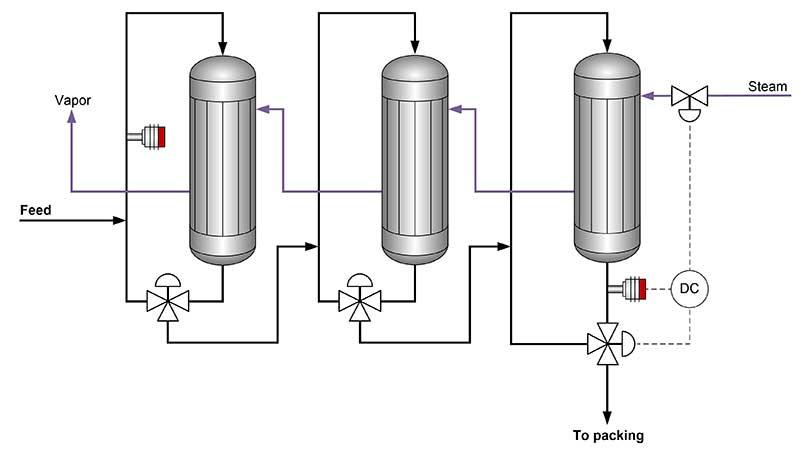


Introduction
Glycerol (Glycerin) is a clear, nearly colorless and viscous liquid with a very sweet taste. It occurs in combination with various fatty acids (glycerides) in all animal and vegetable fats and oils.
Glycerin is produced organically by a number of different methods and by various synthesis processes.
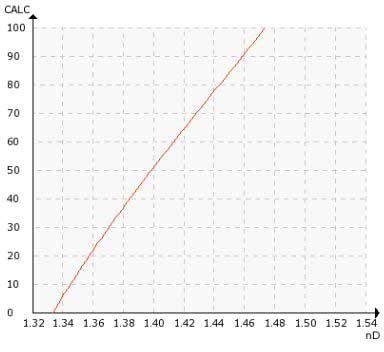
Chemical curve: Glycerol R.I. per Conc b.w. at Ref. Temp. of 20˚C
Application
Natural glycerin is obtained primarily as a co-product from the production of fatty acids and fatty esters, or soap from oils and fats.
Splitting or hydrolysis of oil, under pressure and at high temperature, produces fatty acids and sweetwater. The sweetwater contains 10–20 % glycerol. Transesterification of oil with methanol, in the presence of a catalyst, yields methyl esters and glycerin. Since the process does not use water, the glycerol concentration is higher. Saponification of an oil/fat with caustic soda forms soap and soap lye. The soap lye formed contains 4-20 % glycerol and is also known as sweetwater or glycerin.
Sweetwater or glycerin obtained as a co-product from the above three processes contains impurities and must undergo further purification and concentration, for example, by evaporation..
Typical end products of glycerol (glycerin) evaporation:
- pharmaceuticals
- humectants
- solvent
- sweetener
- emulsifier
- nitroglycerin
- glycerol soap
- moisturizer
Instrumentation and installatio
Vaisala Polaris™ PR53GC Process Refractometer is used to measure the glycerin concentration in evaporation. Automatic control of the evaporator is possible by using the refractometer’s output signal.
The typical measurement range is 0-20 % glycerin and the process temperature is about 50 ºC (122ºF) before evaporation. After evaporation the typical measurement range is 80-100 % glycerin and the process temperature is about 70 ºC (158 ºF).

Polaris PR53GC compact process refractometer
Description
The Polaris PR53GC compact process refractometer is suitable for a wide range of industrial applications. Special alloy materials are available for demanding environments. Convenien installation with Type L coupling. A selection of flow cells available.
User Interface
Vaisala Indigo520 transmitter integrates with Polaris PR53 process refractometers providing an expanded feature set, including a physical display for real-time measurement data and advanced diagnostics, more output options, data logging, and automated prism wash control. This combination enables efficient process monitoring and easy access to diagnostic information.
Measurement range
Refractive Index (nD) 1.3200 – 1.5300, corresponding to 0-100 % by weight.