
Wind Energy scientific digest 2026
A 2026 digest of leading wind energy research, methods, and applications, showcasing how Vaisala’s scientific leadership can best support all wind energy applications

Wind 2026 at a glance
How can lidar measure turbulence more accurately, deliver reliable data in challenging conditions, and help anticipate rapid changes in wind? Vaisala’s 2026 research explores these questions through advances in lidar processing, modelling, and calibration, alongside simulations and field studies. The work covers conditions ranging from low-aerosol alpine environments and complex terrain to long-range offshore measurements. Explore our findings in turbulence assessment, wind-field reconstruction, measurement uncertainty, and wind-ramp forecasting to see how they can support more confident wind-project decisions.
Each year, we bring together selected wind energy research in one place. The 2026 digest features Vaisala’s presentations and posters from the year, including studies conducted in collaboration with industry partners.
WinterWind 2026
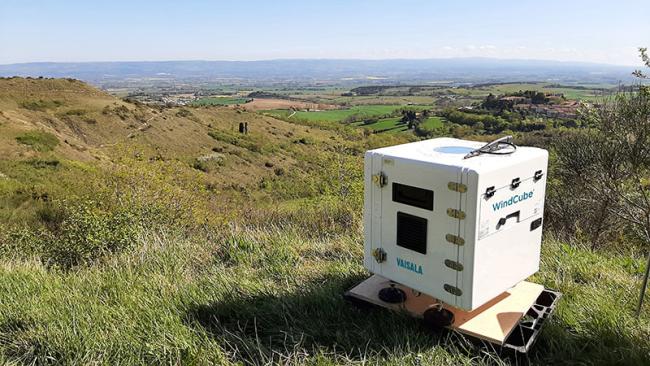
Performance Evaluation of Pulsed Vertical Profiling Lidars in Clean Air Alpine Environments
Clean air and low aerosol levels can limit lidar signal quality and data availability in alpine environments. Two Austrian campaigns compare WindCube 2.1 XP with standard WindCube systems under these challenging conditions. Results show higher availability for the XP model, with further gains from RB3LOS processing, supporting more reliable alpine wind-measurement campaigns.
ACP 2026
Forecasting wind ramps with Scanning Lidar to minimize wind and solar park damages and operational costs
Wind ramps can affect wind-farm operations, energy trading, and grid balancing within minutes. This presentation shows how WindCube Scan measurements can detect, track, and forecast significant wind variations more than 15 minutes ahead. Validation against two years of SCADA data achieved a 96% true-positive rate for defined wind-ramp events, supporting the potential for safer and more efficient operations.
Lidar as a standalone wind measurement solution
As international standards evolve, lidar can support wind projects with less reliance on permanent meteorological masts throughout their lifecycle. This poster covers energy-yield assessment, power-performance testing, permanent monitoring, and offshore applications. It highlights how standalone lidar can provide flexible, multi-height measurements while reducing deployment time, cost, and safety risks.
Reproducibility and uncertainty estimation of new lidar turbulence algorithm at North American sites
In collaboration with RWE, this presentation evaluates Vaisala’s Pure-TI algorithm using blind tests from 14 North American sites and over 9 years of data. The results show that Pure-TI meets key industry KPIs from CFARS, IEA Task 52, and DNV-RP 0661, supporting lidar-based turbulence assessment.
WindEurope 2026
Reliable offshore wind measurements using Dual Scanning Lidars and AI-based wind field reconstruction.
Neural-network range boosting can extend dual-scanning lidar measurements for offshore wind resource assessment. Results from a UK campaign show improved data availability and a longer usable range while preserving wind-speed metrology. The work supports more reliable offshore DSL deployment where long-distance measurements are needed.
Repeatability, reproducibility, and uncertainty estimation of a new lidar TI
In collaboration with Nordex, Pavana, and RWE, this study evaluates Vaisala’s Pure-TI algorithm across calibration and field campaigns in simple and complex terrain. It assesses repeatability, reproducibility, and uncertainty against IEA Wind Task 52 indicators. Results show that Pure-TI meets key proposed criteria for damage index and representative turbulence intensity across defined terrain and wind-speed conditions.
Scan geometry and pulse length effect on turbulence retrieval
Accurate turbulence measurements require an understanding of the effects created by both lidar pulse length and scan geometry. Virtual-lidar simulations separate intra-beam and inter-beam effects on reconstructed wind-speed fluctuations. The results show that inter-beam effects are the principal source of uncertainty, highlighting the value of improved wind-field reconstruction.
WindEurope Technology Workshop 2026
A flow model for every season: model-enhanced lidar measurement campaigns in complex terrain
From campaign planning to post-processing, flow models can help reduce uncertainty in complex-terrain lidar measurements. This presentation compares terrain-complexity estimation, Flow Complexity Recognition, and full CFD across UK sites. The findings show how selecting the right approach can reduce wind-speed uncertainty and improve agreement between lidar and reference turbulence measurements.
Forecasting wind ramps with Scanning Lidar
Wind ramps can affect wind-farm operations, energy trading, and grid balancing within minutes. This presentation shows how WindCube Scan measurements can detect, track, and forecast significant wind variations more than 15 minutes ahead. Validation against two years of SCADA data achieved a 96% true-positive rate for defined wind-ramp events, supporting the potential for safer and more efficient operations.
Lidar classification and calibration uncertainties can be reduced to less than 1% using an SI-traceable, white-box methodology
Developed with Deutsche WindGuard, this document presents an SI-traceable, white-box methodology for reducing lidar classification and calibration uncertainty. By using laboratory calibration data and measurement-model validation, the study shows how environmental sensitivities such as wind shear can be transparently corrected, reducing overall lidar uncertainty to below 1%.
Resources


It's time to take wind energy ever higher
Vaisala is ready to talk about your wind project and how we can make it better. Whether you want to dive deeper into a specific study, benchmark your current approach, or explore a new campaign, we’re here to help.
Want to learn more or have a question? Please reach out via our contact form and we’ll get back to you with concrete next steps for your project.


