WindCube Pure TIᵀᴹ
Physics-based turbulence intensity reconstruction
Improve your wind measurement campaigns with WindCube turbulence intensity (TI) data for turbine selection, site suitability and load assessment.
Turbulence Intensity (TI) is a key parameter in wind resource assessment. It describes how much wind speed fluctuates and directly affects structural loads, fatigue, and turbine lifetime. This in turn determines how effectively the selected turbine model can convert the available wind resource into reliable energy yield over its lifetime. Developers today typically rely on met masts and cup anemometers to get trustable TI for IEC‑class turbine selection and load calculations.
WindCube Pure TI, available through Vaisala Compass®, changes this by reconstructing TI from WindCube measurements using a physics based algorithm designed specifically for vertical profiling lidar.

Introducing Pure TI
For decades, the wind industry has struggled to obtain reliable TI from vertical profiling lidar. After extensive research and testing of multiple approaches, including machine learning, Vaisala has shown that advanced physics based algorithms give the most dependable results.
WindCube Pure TI (Physically Unified Reconstruction of TI) is Vaisala’s new physics based algorithm that corrects inter beam averaging effects and converts high frequency WindCube data into 10 minute, cup equivalent TI statistics you can trust. It delivers high precision averages that more accurately capture wind speed variability.
Grounded in the physical laws of turbulent flow and lidar measurement—not machine learning models trained on limited mast data—WindCube Pure TI systematically corrects instrument biases and closes the gap to cup measurements, providing robust performance across diverse conditions without inheriting site specific imperfections.

Validated across sites, heights and climates
WindCube Pure TI has been validated on a large database covering multiple terrains, climates and heights. Across the global validation database of more than one million 10‑minute records, WindCube Pure TI reduces mean bias in turbulence intensity from 0.014 to just 0.001. Residual bias at individual sites remains tightly constrained within ±0.01 TI units across all 34 site-height combinations and all terrain classes - simple, moderately complex, and complex - demonstrating terrain‑robust, bankable TI performance.
WindCube Pure TI sharply tightens the error spread so that lidar derived TI distributions almost perfectly overlay cup measurements (Wasserstein distance improves from 0.014 to 0.002), while error stays essentially constant with height from 40 m to 200 m. In practical terms, WindCube with Pure TI preserves TI accuracy up to hub height and blade tip, instead of degrading with range as is typical for profilers.
How developers and turbine OEM’s benefit from WindCube Pure TI
Higher confidence, lower uncertainty and better bankability
By reducing lidar–cup TI bias and meeting modern performance KPIs, WindCube Pure TI increases confidence in lidar-based TI for both developers and turbine OEMs. This strengthens the case for using lidar-based TI in design, site suitability and load validation workflows, opening the door to lidar-only or lidar-dominant campaigns where a mast was previously mandatory. The result is lower overall measurement risk, and more efficient project development.
No met mast required for TI in WRA and site suitability
WindCube Pure TI enables developers to use WindCube as the primary source of turbulence information for turbine class selection, site suitability and load assessment, removing the need to build a dedicated met mast just for TI. This reduces permitting and construction complexity, eliminates mast-climbing risk, and lets campaigns start as soon as the lidar is on site. For turbine OEMs, it means they can base load evaluations on high-quality TI from WindCube.
TI exactly where it matters – at hub height and beyond
Because many met masts are shorter than modern turbine hub heights, OEMs and developers often rely on conservative extrapolations of TI to hub and tip heights. WindCube Pure TI uses WindCube vertical profiling lidar - measuring up to 400 meters - to provide TI directly at the heights that drive structural loads, with performance that remains stable with height. This gives developers and OEMs a clearer picture of the actual turbulence experienced by tall turbines across the rotor.
More flexible, efficient measurement campaigns
Lidars are simple to relocate compared to met masts, allowing developers to characterize TI at multiple candidate turbine locations with a single instrument instead of multiple met masts. This supports better‑informed turbine siting and layout design, including in and near existing wind farms where wake‑driven turbulence is a concern.
WindCube Pure TI™ now recognized by Nordex for bankable site suitability

WindCube Pure TI™ measurements have been approved by Nordex for site suitability assessments using WindCube® 2.0, 2.1, and 2.1 XP lidar systems, including sites with slightly complex terrain.
Lidar is becoming a core, trusted input for bankable wind assessment and site suitability, with WindCube and Pure TI helping to drive that change.
Trusted and validated by the wind energy industry
"This technology has proven to be highly effective not only in flat terrain, but also in the extremely complex terrain in Japan that we have observed. It is expected to enable further optimization of wind turbine design and improvement in the accuracy of power production estimates."
Seiya Hasegawa, Wind Assessment Group ENEOS Renewable Energy Corporation (ERE)
“UL Solutions has examined Vaisala's Pure-TI algorithm against an IEC compliant tall mast and found promising initial results regarding the algorithm performance. The Pure-TI algorithm results correlated well to the TI of the cup anemometer and reduced the lidar's turbulence intensity quantification error. In addition, the Pure-TI algorithm performed consistently with increasing height, demonstrating the potential to use the lidar's turbulence intensity at hub height. Vaisala's Pure-TI algorithm strengthens UL Solutions’ confidence in lidar data and continues to push the industry towards innovative solutions.”
Shannon Beebie, Wind Energy Analyst and RSD Specialist, UL Solutions
"PAVANA GmbH investigated the “Pure-TI” algorithm within a joint project involving Nordex, RWE, and Vaisala, using a global dataset from 24 sites. The algorithm consistently improved agreement between the LiDAR-measured damage index (DI) and turbulence intensity (TI) and the cup anemometer references. The repeatability analysis across 39 WindCube V2.1 devices, benchmarked against PAVANA’s 200 m IEC-compliant met mast at Janneby, Germany, showed reduced TI overestimation from ~10–15% to 2–5% across all heights and wind speed bins, while preserving wind speed and direction accuracy."
Dr. Ing. Markus Sommerfeld, Expert Wind & Site Assessment, PAVANA GmbH and Annika Baltzer, Head of Department, Lidar verification, PAVANA GmbH
Product documentation
More downloads

Unlock the full power of WindCube® with Compass
Use Vaisala Compass to get more from every WindCube campaign. By centralizing, validating, and post‑processing WindCube measurements, Compass improves resource assessment accuracy, increases data availability, and gives you clearer, faster insights for site selection and energy yield estimates.
How WindCube Pure TI works in Compass
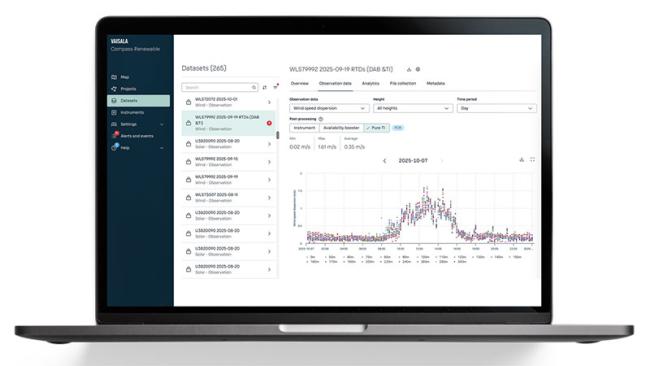
WindCube Pure TI is available as a post‑processing option in Compass Renewable.
Measure with WindCube
Deploy WindCube to collect high frequency wind data at multiple heights up to 400 m, including modern hub and tip heights.
Upload or stream to Compass
Upload or stream WindCube data into Compass, where instruments, datasets and analytics are managed together.
Activate WindCube Pure TI
In Compass Renewable, enable WindCube Pure TI for the selected dataset. Compass runs the algorithm on the 1 Hz signal and recomputes new 10 minute TI values at each measurement height
Analyze and export
Compass manages algorithm versions, tags data with WindCube Pure TI metadata and lets users view TI versus wind speed curves or download files processed with WindCube Pure TI for further analysis and reporting.

Get started today
To discuss how WindCube Pure TI can support your current or upcoming WRA projects, or to see a demo of Pure TI inside Compass, contact Vaisala representative or reach out via your usual Compass support channel.