Expert article
One probe, many configurations: how the XMP10 fits into flexible sensor networks
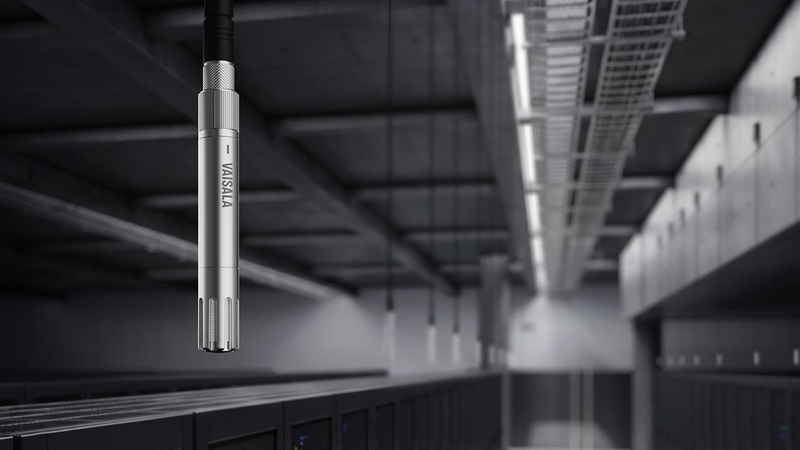



Compact measurement probes are not a new concept. What makes a compact probe worth specifying over a conventional transmitter is whether it can be deployed the way the application actually demands. It’s not just a matter of the cases the product was designed around, but in the ones that come up later when the facility changes or the requirements tighten. The XMP10 humidity and temperature measurement probe is built around that question. It is small, it connects simply, and it is designed to work within network architectures and integration frameworks that give the overall monitoring system room to adapt.
Small form factor, serious installation flexibility
The XMP10 measurement probe measures temperature and humidity in a compact housing with an M8 plug-in connector. That connector is the most immediately practical feature. It requires no tools, no access to terminal blocks, and no stripping of wire ends. The probe plugs in, the measurement is live, and if the probe needs to come out for e.g. calibration, relocation, or replacement, it unplugs in the same way. In a data hall with dozens of measurement points, that difference in installation time adds up quickly during commissioning and continues to save time every time a probe needs to be touched.
The compact housing makes installation positions available that a larger transmitter cannot reach. Think of the inside of a rack, a coolant distribution unit inlet or outlet, an aisle end cap, or a containment corridor; the XMP10 probe fits where the measurement needs to be, rather than where a larger device can be mounted.
Daisy chain: expanding coverage without expanding cable runs
The XMP10 measurement probe is designed for daisy chain RS-485 networks, which changes the installation arithmetic significantly. In a point-to-point analog deployment, each sensor requires a dedicated cable run back to a DDC panel or DDC. For a deployment of 20 probes covering a full data hall, that means 20 cable runs, 40 I/O points at the panel, and 20 individual commissioning steps. Adding a probe later means pulling also a new cable and adding the needed I/O points.
In a daisy chain network, probes connect to each other sequentially along a two-wire RS-485 bus, and one cable run serves a whole row. Adding a probe simply means connecting it to the existing chain. The bus can extend up to 500 meters, which is enough to cover the full depth of a large facility without signal degradation or repeaters. Moving a probe means unplugging it from one point on the chain and reconnecting it at another, and the bus address follows the device.
For a facility that expects to grow with more racks, more cooling zones, and more measurement points, the architecture is significantly easier to extend than a point-to-point wiring approach. The physical installation decision made at first fit-out does not constrain what can be added later.
Host devices: putting a management layer above the chain
A daisy chain network of XMP10 probes becomes substantially more capable when a dedicated host unit sits above it. Two options suit different deployment scales and integration requirements.
Indigo Supervisor is designed for large-scale probe networks. It connects up to 100 probes across two independent RS-485 chains and presents the full network to a BMS as through a single source through Modbus TCP. That single integration point simplifies the BMS configuration considerably: instead of addressing 50 or 100 individual devices, the BMS reads from one. When new probes are added to the chain, they are detected automatically. Calibration management is handled at the unit level: a pre-calibrated spare is swapped in, the Supervisor detects it, and the measurement point is back in service before the outgoing probe has left the facility. A considerable advantage also is that the touchscreen interface and web UI allow configuration and monitoring without requiring access to the BMS or the monitoring room.
Origo transmitter is the right host for smaller deployments or zone-level installations where the transmitter and probe need to work as a single configurable unit. The Origo body accepts interchangeable probes, which means the transmitter stays in place while the probe can be changed out for a different measurement type, a different accuracy class, or a replacement after calibration, without touching the wiring or the BMS integration. More than 100 product configurations are available through combinations of transmitter body, probe type, and output option. A monitoring system that starts with basic temperature and humidity measurement can be extended to dew point, CO2, or differential pressure at the same installation point by changing the probe. That replaces what would otherwise be a new sensor procurement, a new cable run, and a new integration step.
Both host options bring structured management to what would otherwise be a collection of individually addressed field devices. The choice between them depends on the scale of the deployment and the level of integration capability required.
Output options: connecting to whatever is already there
A probe network that can only connect one way is not genuinely flexible. In a real facility, the preferences of end users may differ, the BMS may be one generation old or several, the DDC panels may be from different manufacturers, and different zones may have been integrated by different contractors. The monitoring layer needs to match the infrastructure, not require the infrastructure to change.
The XMP10 probe and its host platforms support multiple output options: analog 4-20 mA and 0-10 V for maximum compatibility with existing panels, Modbus RTU for RS-485 bus integration, Modbus TCP for Ethernet-connected BMS systems, IO-Link for zone-level smart sensor deployments, and BACnet for facilities where the BMS is BACnet-centric. The output protocol is selectable to match whatever the integration on the other side requires.
That flexibility matters most when a facility changes hands, when a BMS upgrade does not happen all at once, or when a new cooling zone uses a different integration standard than the rest of the building. A sensor platform with a fixed output type requires workarounds in those situations. A platform where the output is a selectable configuration parameter does not.
Built for the facility you have, and the one it becomes
The case for the XMP10 probe in a data hall is not any single one of these features. Instead, it is the combination: a probe compact enough to be placed precisely where the measurement belongs, an M8 connector that makes installation and replacement quick, a daisy chain architecture that lets coverage expand without rewiring, host units that bring management and BMS integration to the full probe network, IO-Link support that adds continuous device health visibility and remote parameterization at the zone level, and output options that connect to the integration infrastructure already in place.
Together, that is a monitoring layer built with the same modularity principle as the rest of the facility; one that can grow, adapt, and be reconfigured as the data hall around it changes, without requiring the original installation decisions to be undone.
Curious whether the XMP10 is the right fit for your deployment? Talk to one of our measurement specialists, they know the applications and can help you design a sensor network that works for the facility you are building.
Talk to a data center measurement specialist
Whether you are at the design stage, expanding an existing facility, or reviewing your asset monitoring strategy, our specialists can help you identify the right measurement approach for your application.