Expert article
How hybrid road weather observation networks enable proactive winter maintenance



Building the observation density needed for hyperlocal forecasting, enabling proactive operations
Road maintenance professionals face more severe weather, tighter budgets, and rising public expectations. The answer lies in working smarter through proactive, data-driven operations. This transformation depends on accurate hyperlocal road weather forecasts that tell maintenance teams exactly when, where, and how to act before conditions become hazardous.
Those forecasts, in turn, depend on dense, high-quality road weather observation networks that capture how weather truly impacts roads. This is where the hybrid approach becomes essential, strategically combining reference-grade road weather stations with targeted infill wireless sensors and mobile sensors to create the observation density that enables hyperlocal forecasting, in a cost-efficient way.
Comprehensive network intelligence
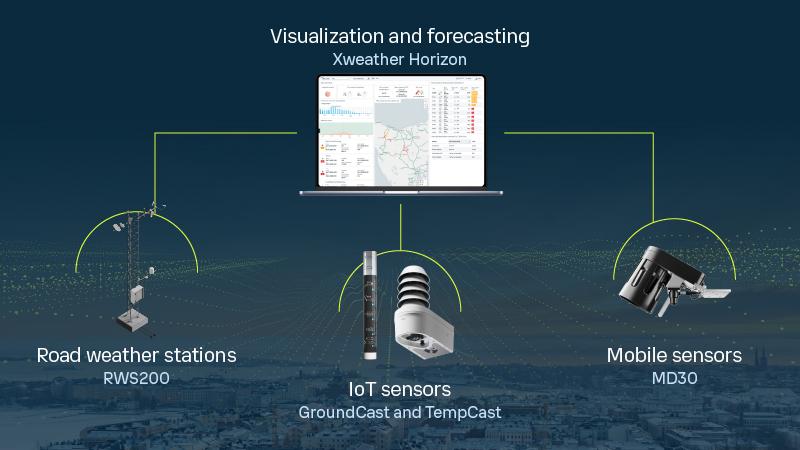
| Reference-grade stations provide backbone data |
| Infill sensors provide local detail |
| Mobile sensors provide real-time validation |
| ||||
Hyperlocal forecasting, enabling proactive maintenance | ||||
The challenge: Your roads generate microclimates that broad forecasts cannot predict
Road weather differs fundamentally from atmospheric weather. Snow falling on a warm road melts away without intervention, while the same snowfall on a cold bridge deck creates black ice. Bridges and elevated sections freeze much earlier than nearby ground-level roads because they lose heat both above and below the surface. Valleys trap cold air, shading creates cold spots, and factors like traffic volume, pavement construction, solar radiation, and urban heat islands all influence how weather impacts individual road segments.
These local variations create the microclimates that make road weather challenging to predict. Observation density becomes the critical factor. More observation points capturing local variations mean forecast models can account for the true complexity of road weather conditions. Sparse networks miss these variations, forcing forecasts to generalize and losing the precision needed for confident preventive action.
Forecast accuracy and confidence improve when local variations are observed.
The solution: Building the right observation density for your road network
Building observation density cost-effectively requires understanding that different technologies serve different purposes. Any effective road weather observation network starts with reference-grade road weather stations as the foundation. These stations provide the full suite of atmospheric and road surface parameters required for numerical weather prediction models, including air temperature and humidity, wind speed and direction, precipitation type and intensity, visibility, and multiple road surface measurements including temperature, state, grip, and residual chemical concentration. They provide the anchor points that forecast models use to generate localized predictions.
Once this reference-grade backbone exists, infill sensors play their critical complementary role. These sensors focus on the most critical road-level parameters, primarily road surface temperature and road state. Because the infill sensors are wireless and battery powered, they can be also be deployed where reference-grade stations would be impractical. Bridges can have dedicated sensors capturing their unique freezing behavior. Valleys, corridors, and known cold spots can be instrumented affordably. Together with existing road weather stations, they provide comprehensive coverage of your whole road network, even in challenging areas such as bridges and remote locations.
Mobile sensors add a third dimension. They provide real-time feedback from snow plows and patrol vehicles on the road about current conditions, including road surface temperature, layer thickness, and live grip data. They validate that conditions match forecasts, confirm that treatments are working as intended, and identify unexpected problem areas that may need additional attention. This combination enables both strategic planning based on forecasts from fixed sensors and tactical adjustment based on real-time validation from mobile sensors.
The power of this hybrid network emerges when all three technologies work together, transforming this data into actionable forecasts. Vaisala Xweather Horizon combines data from your array of local sensors with more than 70 other data sources to power advanced machine learning-based weather prediction. A single reference-grade station might show general conditions for a region. Adding infill sensors at bridges, in valleys, and at known problem spots reveals how those locations behave differently. The forecast model can now predict not just regional conditions but the actual behavior of individual road segments.
The value: Measurable improvements in operations, costs and sustainability
Accurate hyperlocal forecasts enabled by dense observation networks transform how winter maintenance operates. The critical shift is from reactive response to proactive prevention. When forecasts are accurate enough to trust, teams can pre-treat at the optimal time, late enough that materials will not wash away but early enough to prevent ice formation. This maximizes effectiveness while minimizing material use.
Many road maintenance agencies have historically treated entire networks preventively on marginal nights. Instead of treating 500 kilometers of road network because one bridge might freeze, agencies can now treat that specific bridge and other confirmed cold spots while leaving areas that will remain above freezing untreated.
The results are measurable. Calderdale Council in West Yorkshire faced unique challenges with its 660-kilometer road network, where routes quickly transition from hilltops to valley bottoms and temperatures vary dramatically over short distances. After adopting Xweather Horizon, the council stopped treating its entire network "just in case" and started relying on targeted, data-driven treatments where and when needed. The results included targeting treatments more precisely and reducing unnecessary salt use and operational costs.
Beyond cost savings, safety improves when roads are treated proactively before conditions become hazardous. Environmental sustainability benefits mirror the operational improvements. Targeted treatments use less treatment material, reducing salt runoff into local waterways and ecosystems. Lower fuel consumption through optimized fleet operations reduces carbon dioxide emissions. Appropriate material application instead of over-treatment reduces infrastructure corrosion, extending the life of bridges, vehicles, and equipment.
Getting started: Matching technology to network complexity
Building an effective hybrid observation network requires strategic thinking about where each technology adds the most value. Start by establishing or evaluating the reference-grade backbone. Where are the representative sites that capture major weather patterns affecting your network?
Next, identify locations where observation density needs to increase. Where are the known problem areas: bridges that freeze first, valleys that trap cold air, corridors with unique exposures, cold spots that consistently cause issues? Where does terrain complexity create microclimates that differ from regional patterns?
Match technology deployment to the specific characteristics of each location. Areas with existing infrastructure and the need for comprehensive data may warrant additional reference-grade stations. Locations needing targeted road surface monitoring without full atmospheric measurement are ideal for infill sensors. Bridges, remote areas, and locations lacking power infrastructure are natural infill sensor candidates.
Network expansion typically proceeds incrementally as operational experience and budget allow. Initial deployments target the highest-priority locations where improved forecast accuracy has immediate operational benefit. These benefits compound over time. As observation networks mature and forecast models learn the specific characteristics of local areas, accuracy continues improving. Operations become increasingly efficient as teams gain confidence in forecasts and refine strategies based on accumulated experience.
The transformation ahead
The hybrid approach to road weather observation networks represents a fundamental transformation in how winter maintenance operates. It shifts the operational model from reactive response to proactive prevention, aligning with broader trends in transportation management toward data-driven decision-making and performance-based operations.
Winter weather will always present challenges. But hybrid road weather observation networks give maintenance agencies the tools to meet those challenges proactively, efficiently, and sustainably. The transformation from reactive crisis management to strategic, data-driven operations delivers measurable value in safety, cost efficiency, and environmental stewardship, making winter maintenance more effective precisely when weather patterns are becoming less predictable and public expectations continue to rise.
Kanang Sivula serves as Head of Roads, Europe at Vaisala, where she focuses on winter maintenance solutions, helping customers improve road safety and efficiency. With a technical background spanning radiosonde systems and lidar based observations, and a Master's degree in Technology from Tokyo Institute of Technology, Kanang bridges the gap between advanced measurement technology and practical customer needs.
Actionable insights for more efficient winter road maintenance
Winter weather is a threat to safe and efficient travel, and it can cause damage to road networks. To make informed road management decisions, you need effective monitoring solutions and timely access to accurate surface condition data and accurate road weather forecasts for snow and ice events.
Get actionable insights and experience confident proactive operations to deploy scarce resources efficiently, increase road mobility and reduce the environmental impact. Meet budgetary and performance metrics while increasing worker safety and decreasing their time spent on the road.
Contact Us
Ready to see how Vaisala’s sensing technology can be put to work for you? We’re here to help! Please contact us and our industry experts will be in touch quickly to discuss your weather and environmental monitoring challenges.