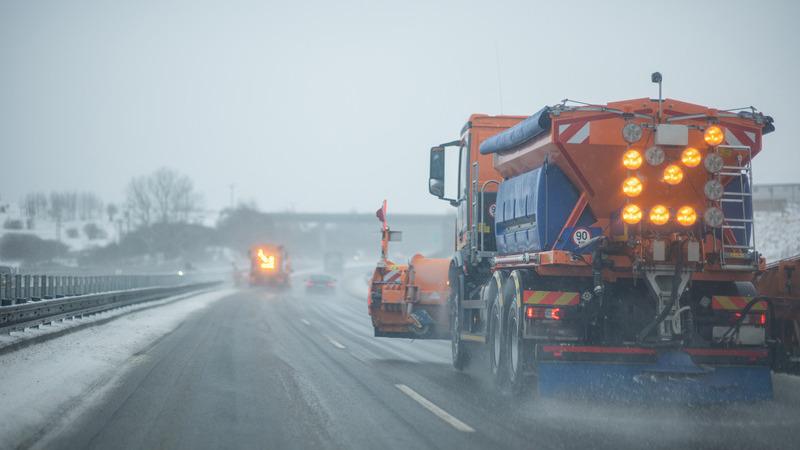


Winter road maintenance agencies across North America are achieving salt reductions between 30% and 55% using a new technology called dynamic spreading. The system uses real-time road condition data from onboard sensors to automatically adjust material application rates as plow trucks operate.
The technology emerged from field experience with mobile road weather sensors. When winter maintenance operators began using these sensors on snowplow operations, they gained real-time insight into road conditions after plowing. The addition of grip data helped them make better decisions about material application. This led to a critical question: Could the system apply material automatically based on sensor readings?
How the system works
Dynamic spreading uses the MD30, a noninvasive mobile road sensor mounted on the front bumper of snowplow trucks. The sensor is positioned behind the plow blade on the driver's side, aimed at the wheel track to measure pavement conditions after plowing. The MD30 sensor measures grip, surface state, surface layer thickness, surface temperature, air temperature, dew point and frost point, and relative humidity. It integrates directly with computerized spreader controllers that several manufacturers now support.
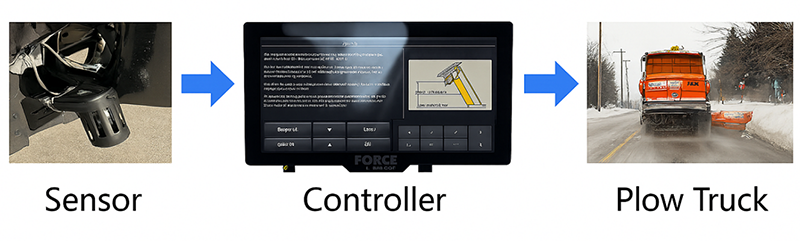
In North American dynamic spreading deployments, grip and pavement temperature work together to determine material application rates, with grip serving as the primary governing parameter. Agencies work with sensor and controller manufacturers to define application rates based on these sensor parameters, their level of service requirements, cycle times, and materials used.
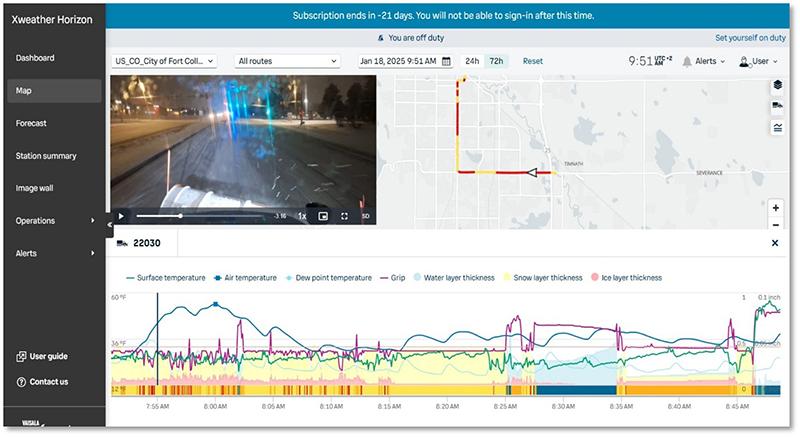
For dynamic spreading, the sensor connects directly to the spreader controller. Agencies can optionally transmit sensor data to the cloud through a windshield-mounted unit for visualization and mapping. The data appears as mapped parameters with frequent images in the manufacturer's software. Some automatic vehicle location providers can also display the data when integrated with the controller.
Proven results from the field
City of Fort Collins, Colorado has been testing dynamic spreading since the program's inception. Their findings have been consistent across multiple winter events. The dynamic spreading routes use substantially less material than constant spreading routes.
In January 2023, City of Fort Collins achieved a 45% reduction in salt consumption compared to their standard application. February 2024 showed even better results with a 55% reduction. The total snow season salt savings reached 44%.
Other agencies have reported reductions between 34% and 45%, including Massachusetts DOT, City of West Des Moines, and sites in Canada. Several additional agencies – including West Des Moines, Iowa and Lincoln, Nebraska – have begun implementing dynamic spreading and are expected to report results following the 2026/2027 winter season.
Setting application rates
Early pilots used simple rate structures based on grip readings. City of Fort Collins set four application levels for their two-hour route cycle using pre-wetted salt. Their standard practice allows constant rates up to 300 pounds per lane mile.
For dynamic spreading, they applied 25 pounds per lane mile when grip measured above 0.60 and material was needed. Between 0.50 and 0.60 grip, they applied 100 pounds per lane mile. Between 0.40 and 0.50, the rate increased to 200 pounds per lane mile. Below 0.40 grip, trucks applied the maximum 300 pounds per lane mile.
Treatment suggestions: Grip and pavement temperature
| Grip | Pavement Temp | Roadway Description | Action (Pavement Temp Rising) | Action (Pavement Temp Falling) | |

| .82-.60 | 30-34 | Dry to generally wet | None | 50 − 100 lbs/lnm |

| .50-.60 | 25-32 | Slushy to snow covered | 50 − 100 lbs/lnm | 100 − 150 lbs/lnm |
| .40-.50 | 20-25 | Snow covered, perhaps wheel tracks | 100 − 150 lbs/lnm | 150 − 200 lbs/lnm | |

| .40-.45 | 15-20 | Snow covered with possible pack | 150 − 200 lbs/lnm | 250 − 300 lbs/lnm |
| .30-.40 | 15-20 | Slippery and ice likely | 200 − 300 lbs/lnm | 250 − 300 lbs/lnm | |

| <.30 | <15 | Icy covered | 350 − 400 lbs/lnm | 400 lbs/lnm |
Disclaimers
When pavement temperatures drop near 15°F or below, many agencies use alternative chemicals. Agencies should follow manufacturer's recommendations and their own policies. Treatment rates are suggestions based on 2-hour cycle times while plowing and using pre-wetted salt. Some agencies use high volumes of liquids and that would reduce these rates. Vaisala accepts no responsibility or liability with respect to these suggestions, and agencies should follow internal policies and levels of service.
Figure 3: Example material suggestion matrix used to define dynamic spreading application rates based on grip and pavement temperature.
Other agencies chose different rates based on their operations and cycle times. The system accommodates agency-specific parameters and service levels.
Next steps for the technology
Field results have demonstrated that dynamic spreading delivers consistent material savings across different agencies and regions. The technology is currently deployed with a limited number of vendors and agencies. As adoption expands, the system will continue to be refined and enhanced.
Future enhancements may incorporate layer thickness as an additional parameter alongside grip and pavement temperature. Road weather forecasting may also play a role in optimizing application decisions. Artificial intelligence represents another potential advancement. Machine learning could optimize application rates based on accumulated data from thousands of winter operations.
Beyond material savings, dynamic spreading reduces cognitive load on operators. This should decrease operator fatigue and increase safety, though that was not the focus of initial field tests.
The technology is not exclusive to North America. Development efforts are also underway in Europe and Japan. Dynamic spreading represents the first step in operator-assisted winter maintenance that promotes safety while reducing the environmental impact of salt application.
________________________________________
This expert article is based on research presented at the 17th World Congress on Road Winter Service, Resilience and Decarbonisation, held in Chambéry, France, March 10-13, 2026: Automating Salt Application Rates using On-Board Sensors for Spreading Control, Mark DeVries and Bert Murillo, Vaisala, and Wilfrid Nixon, City of Pella, Iowa.
Contact us
Ready to see how Vaisala’s sensing technology can be put to work for you? We’re here to help! Please contact us and our industry experts will be in touch quickly to discuss your weather and environmental monitoring challenges.