From traditional met masts to modern lidar


The client: Juwi
Vaisala solution: WindCube
THE CHALLENGE: Conducting accurate wind resource assessments at constantly growing measurement heights across a variety of terrains
Germany’s onshore wind power capacity is growing fast and will continue to rise steadily over the next few years in order to meet the need for cleaner power. Thus far, Juwi has realized around 1,000 wind turbines with a total capacity of approximately 2,400 megawatts at more than 180 sites.
However, with wind turbines growing taller and reaching heights of more than 170m, established technologies such as meteorological masts (met masts, met towers, etc.) struggle to deliver accurate measurements at such great heights. Plus, the correspondingly tall masts have become prohibitively expensive to install and maintain, with the lighting and permitting required significantly increasing costs. Additionally, with the best simple terrain sites already in use for wind farms, Juwi now must prospect for possible opportunities in increasingly complex terrains. Because correct estimation of available wind energy can make or break the economics of a wind farm, accurate estimates of the wind resource potential at a given site are crucial to any project’s success. In previous development projects, Juwi deployed lidars alongside met towers to evaluate the wind shear and icing, but building, permitting, and installing met masts tall enough to deliver accurate measurements had become increasingly complicated and inefficient, time-consuming, and costly.
Consequently, Juwi aimed to utilize standalone WindCube® lidar units across terrains to gather and analyze precise measurements for wind resource assessments, as well as power curve measurements.
“WindCube suite is outstanding in stand-alone applications. Not only is the lidar very stable and easy to use, but it provides the precise measurements and accurate data we need for wind resource assessments and power curve measurements.”
Matthias Benz Team Leader, Wind Measurements & IT at Juwi
THE APPROACH: Vaisala WindCube
The industry standard vertical profiling lidar for accurate, bankable wind data, WindCube data has been validated by hundreds of independent studies and accepted by all international standards and guidelines. Measuring wind speed, wind direction, turbulence intensity, vertical wind speed, and ensuring high data availability at 12 simultaneous heights all the way up to 200m*, WindCube helps Juwi secure funding while minimizing risk
Juwi selected WindCube as its preferred remote sensing technology because of its transportability, ease of installation, high data availability, and ability to accurately measure data suitable for modern wind resource assessments, where turbine blade tip heights exceed the reach of met masts.
THE RESULTS: Mobility, ease of deployment, reliability, and better, more acceptable data
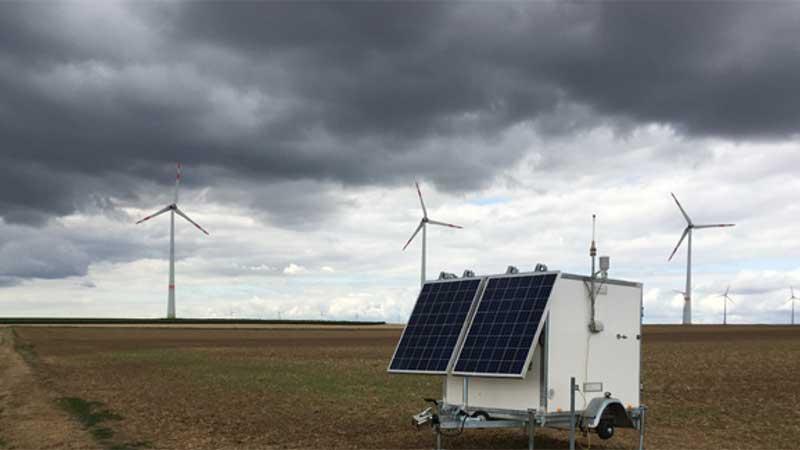
At one development project near Berlin, Juwi experienced the reliability of WindCube lidar firsthand. Juwi installed WindCube during the spring of 2020, and due to the technology’s high data availability, the company has not yet had to conduct any site visits (as of November 2020).
Also, the ability to quickly change positions and sites is crucial for Juwi. By being able to transport the entire WindCube device to different locations using the trailer solution from GWU, Juwi doesn’t need any permitting — it only requires a contract with the landowner, making it very easy to install the lidar almost anywhere.
Now, thanks to the technical guideline TR6, published by the German "Fördergesellschaft Windenergie und andere Erneuerbare Energien,” standalone lidar measurements are accepted by Juwi's external consultants, even in complex and forest terrains. To that end, Juwi is able to operate without installing met towers because the lidar campaigns are bankable and uncertainties don’t rise much when measuring in complex terrains.
Looking forward, Juwi aims to utilize its fleet of WindCube lidars on additional wind farm projects, and the company is confident that lidar is becoming the standard in wind energy because of the technology’s cost, flexibility, and ease of deployment.