Roads We All Drive On


For many years, municipal authorities have watched larger state, provincial, and ministry agencies purchase networks of road weather stations for use in improving winter decision making. Municipal authorities discovered the data was not the same for their roads.
All Roads are Not Created Equal
The City of West Des Moines, Iowa, is much like many municipal communities around the United States. A suburb of the City of Des Moines, Iowa, West Des Moines is a growing city with commerce and the movement of its residents and commuters at the heart of the City’s success. The City of West Des Moines consists of over 800 lane miles (1280 km), and has a fluctuation in population of approximately 120,000 during the day down to 66,000 at night. This further highlights the importance of keeping surface transportation moving at all times. Iowa also can be a harsh climate in the winter, with lots of winter precipitation events. Positioned in the northern Midwest places it directly in the path of many winter storms, and even when storms go north or south of the region, Iowa still receives a glancing blow.
This winter climate presents a challenge to the City of West Des Moines Public Services Department; thus, any tool they can find to make their decision-making easier can benefit them. For years, the City watched the Iowa Department of Transportation install Road Weather Information Systems (or RWIS) along the interstates and state routes across Iowa. They eventually received access to the data for their use, and found the data difficult to apply to the local streets. “We found the data was not matching what we were seeing from mobile data in our trucks, or what our folks were seeing on the roads,” said Kevin Hensley City of West Des Moines Superintendent of Public Services. Hensley went on to add, “Interstate roadways and local street networks react differently to winter conditions due to many factors. When RWIS stations are located on the interstate systems, the data supervisory staff is using to make decisions is not representative of their local street network.” Therefore, The City of West Des Moines decided they needed their own RWIS stations.
Challenge
- City depends on mobility to keep commerce growing
- Road Weather data from interstates is not representative
- City did not have money for a large capital purchase
Solution
- Joint development of Vaisala RoadDSS On-Demand
- City of West Des Moines can see road information from their streets
- West Des Moines does not need to worry about maintenance of the system
Benefits
- Easier winter decision making by Public Service Department
- Keeps West Des Moines as an attractive location for businesses and residents
- Saves money on winter maintenance operations
Partnering to Solve a Problem
The City of West Des Moines still had one problem with RWIS; it was not sure how it could fund such technology. Cities like West Des Moines do not have the budget like a larger agency, and thus figuring out how to fund the purchase of the stations, installation costs, and data and collection fees can be a lot for any city. Purchasing and installation are really only half the battle. Any electronic technology outside will need maintenance and repairs as well, so thinking of an ongoing budget for such a weather system added to the challenge.
The City of West Des Moines had been working with Vaisala on a weather sensor that mounted to a moving supervisor vehicle, and other numerous educational opportunities. Therefore, it was easy to see how the two began to work on a solution, so the City could see RWIS data from their own network of streets in an economical way. “We also want to provide the street weather data to our Maintenance Decision Support System (MDSS) and weather forecasting vendor, so it could help their forecast accuracy,” explained Hensley. Vaisala and West Des Moines were able to create a solution now known as Vaisala RoadDSS® On-Demand.
All We Need is the Data
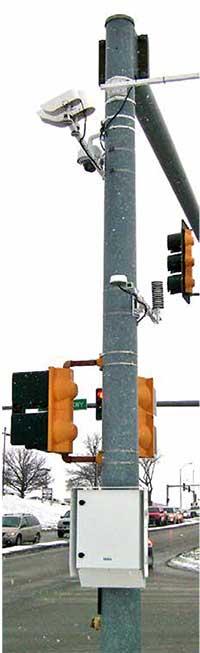
Vaisala RoadDSS On-Demand is different from anything offered by a road weather provider. On-Demand is a subscription service, meaning the City had no upfront costs. They pay a monthly fee for access to an RWIS station located on their city street. Vaisala retains ownership of the system and the responsibility to it, so Vaisala covers all maintenance, installation, and data collection. West Des Moines can view their information over a cloud-based software anywhere! They can configure alerts to warn them of changing weather conditions, and they have the latest sensors on the station. “We focused on the pavement temperature at first, but now we also find value in looking at the friction being reported by each station,” explains Hensley. The City of West Des Moines began with a single weather station, but now has found value in having three stations positioned around their city, and they are even considering more. The solution created by West Des Moines and Vaisala has helped maintain the City as one of the leading experts on road weather technology in the United States, and more importantly, kept their city and its economy moving!