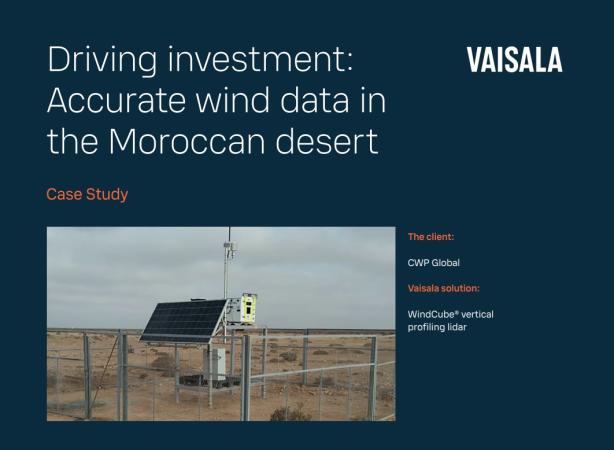
Accurate wind data in the Moroccan desert


The client: CWP Global
Vaisala solution: WindCube® vertical profiling lidar
THE CHALLENGE:
Measuring wind across the vast Moroccan desert
CWP Global develops large-scale renewable energy and green hydrogen projects across Europe, Australia, Africa and South America. The group manages the AMUN project in Morocco's Guelmim-Oued Noun region — an ambitious green hydrogen initiative targeting up to 17 GW of renewable generation capacity at full scale.
The site spans 5,500 square kilometers of diverse terrain including lowland, plateau, and desert areas. Traditional meteorological masts (met masts) would have required extensive infrastructure across this vast landscape. CWP needed a flexible, cost-effective wind measurement solution to deliver high-quality, bankable wind data.
As Dmitriy Dubov, Resource Assessment Lead at CWP, explained, “The vast project area requires us to plan the measurement campaign in subsequent stages, with the aim to increase the spatial coverage across the site and therefore reduce any modelling related uncertainties.”
THE APPROACH:
Conquering complexity with flexible wind lidar
WindCube lidar technology was the ideal choice for their wind resource assessment (WRA) — in fact, they didn’t even consider other options. “Lidar usage was included in our strategy from the very beginning. WindCube was chosen as a proven solution from other projects,” Dmitriy said.
They deployed WindCube as both a standalone “roaming” unit and alongside traditional met masts to maximize spatial coverage, moving the lidar to different locations to capture a comprehensive picture of wind conditions across the site.
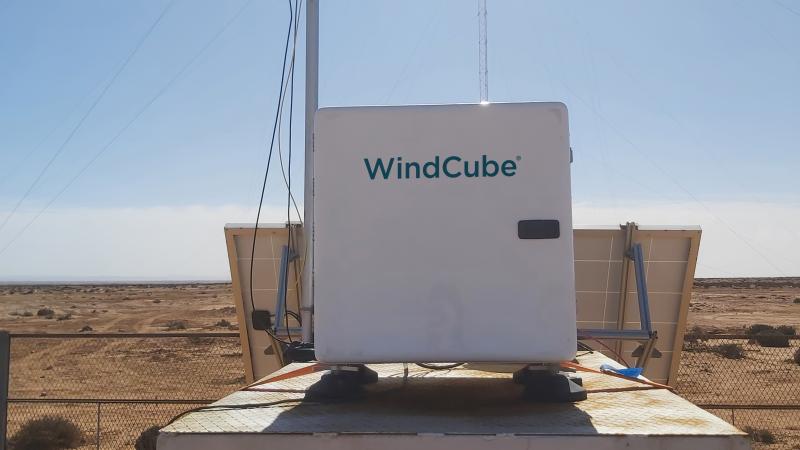
CWP was keen to adapt to the local climate. As Dmitriy put it, “Harsh climatic conditions increase the complexity further. The WindCube sustained reliable operation even under challenging environmental conditions characterized by high dust levels, sand exposure, and extreme weather. With well-coordinated logistics and the implementation of protective shading, its performance remained stable and consistent.”
WindCube’s flexibility was a key advantage. Its compact design and ease of installation allowed for rapid deployment, even in remote and difficult-to access locations. The installation process itself was straightforward and fast, though selecting a suitable power supply in the desert environment required careful planning. Dmitriy said, “The installation of WindCube is incomparable with the masts in terms of easiness and safety… Without a lidar, [using a met mast alone] would make the spatial coverage of the project area much more complicated and costly.”
Calibration and data quality were also priorities. The team co-located the WindCube with met masts for calibration and found the correlation between lidar data and met mast data was very high. Third-party verification provided additional assurance of data accuracy and reliability.
“Thanks to WindCube, we were able to reduce spatial uncertainty significantly by being able to measure at different locations.”
Dmitriy Dubov
Resource Assessment Lead, CWP
THE RESULTS:
Bankable data that drives investment
Using WindCube lidar brought big advantages to the AMUN project. By measuring wind at many different spots, the team was able to reduce uncertainty and get more accurate energy estimates.
The lidar data matched very closely with met mast data, and third-party checks confirmed the results were reliable and could be trusted by investors.
WindCube’s flexibility and toughness made it easy for the team to cover the whole project area without much hassle or extra cost. This thorough data collection helped boost the project’s credibility and gave everyone more confidence in its success.
Looking ahead, CWP plans to use WindCube as the primary measurement device in future WRA campaigns. They recognize WindCube’s ability to deliver reliable, high-quality data in even the most challenging environments.