Curious like Ada Lovelace: two Vaisala inventors patent their ideas
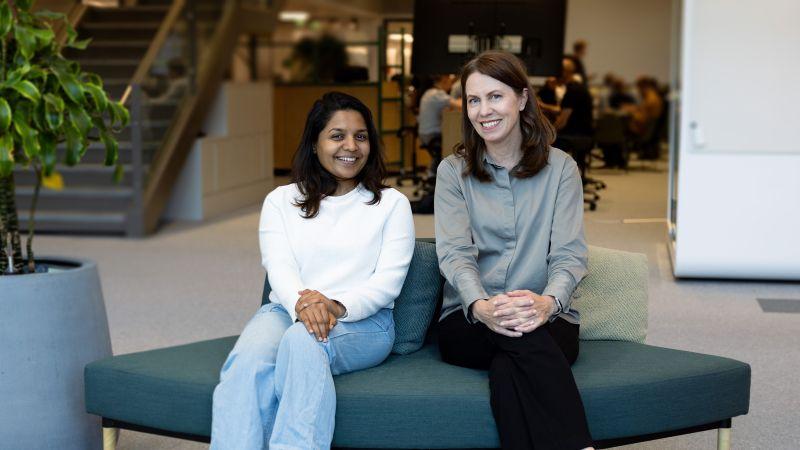
Ada Lovelace Day, marked worldwide on October 13, celebrates the mathematician who wrote the first algorithm designed for a machine and, through her, the achievements of women in science and technology since. At Vaisala, two women have their own claim to that legacy. Kaisa Lehmus and Lashani Wickramanayake each hold a patent that started the same way: they noticed something odd, asked why, and kept testing until they had an answer worth protecting. Here are their stories.
Kaisa Lehmus: a strange reading that became a new way to measure
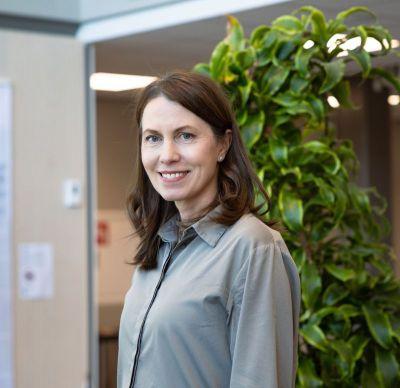
The idea began with a customer problem. Vaisala's Humicap® humidity sensors were giving strange readings in vaporized hydrogen peroxide, and Kaisa Lehmus with Jukka Leppänen were among the scientists working to understand why.
Extensive theoretical studies and repeated sensor chip trials followed. What emerged became the patent: two humidity sensors working as a pair. One reads humidity from air containing hydrogen peroxide. The other carries a catalytic layer that breaks the hydrogen peroxide down into water and oxygen first, so it reads plain water vapor only. Comparing the two signals reveals exactly how much hydrogen peroxide is in the air.
And because the same principle works for other reactive gases with the right catalytic material and sensor design, the patent covers more than one product.
Vaisala has built that work into its HPP270 series, used to measure vaporized hydrogen peroxide. The invention opened a new line of business in life-science applications, gave Vaisala a sensor technology platform it can develop further, and has left the company with no competitors offering the same measurement technology. For customers, it means reliable monitoring and better control of bio-decontamination and sterilization processes. For society, it supports safer, cleaner, and more controlled environments across life science, pharmaceuticals, and healthcare.
"Innovation often starts with a simple question or an experimental observation you don't fully understand at first," Kaisa says. Her advice to other women in tech: trust your curiosity, speak up about your ideas, and remember that the best solutions usually come from people with different backgrounds working together.
Lashani Wickramanayke: what Lego bricks revealed about hail
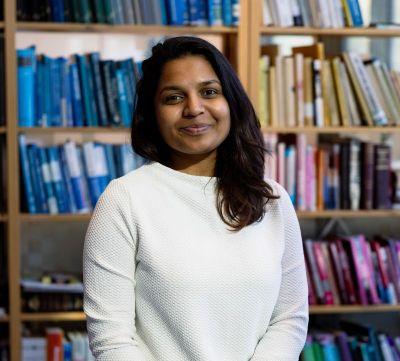
Lashani Wickramanayake's patent began with a question that had nothing to do with hail. She was working with acoustic transducers, sensors normally used to transmit signals, and wondered whether the same component could work in reverse: could it listen instead of speak?
She and her supervisor Reino Keränen tested the idea in the simplest way they could think of. They placed a transducer behind a solar panel and hit the panel surface with Lego bricks to simulate impacts, watching an oscilloscope the whole time, half expecting nothing. Instead, they saw clear impulses, a distinct spike every time a hit landed.
That result pointed toward a real problem. Hail damages solar farms, and today there's no easy way to know how bad that damage is without sending someone to physically inspect hundreds or thousands of panels.
Lashani's invention attaches an acoustic sensor directly to a surface, a solar panel, a roof, or any large piece of infrastructure. When hail strikes, the sensor picks up the impact as a sound wave traveling through the material, and signal analysis extracts how hard the impact was, how often hail is hitting, and potentially how large the stones are. The infrastructure, in effect, tells you it's being hit by hail, in real time.
In the United States, hail costs solar operators heavily each year, and they still struggle to measure the damage automatically and in real time. Lashani’s approach gives them a low-cost, scalable way to monitor hail impact directly on their infrastructure, speeding up damage assessment and improving maintenance decisions.
For Vaisala, it strengthens a field the company already has deep expertise in: severe weather impact monitoring. For society, it supports the reliability of renewable energy infrastructure, which matters more as solar continues to scale globally.
"You don't need a complicated setup or an expensive lab to test a big idea," Lashani says. "We used Lego bricks and an oscilloscope. That's it."
Her advice to other women in tech: trust curiosity over perfection. Ask the odd question, test it quickly and simply, and don't worry if the first attempt looks silly. Hers did too.
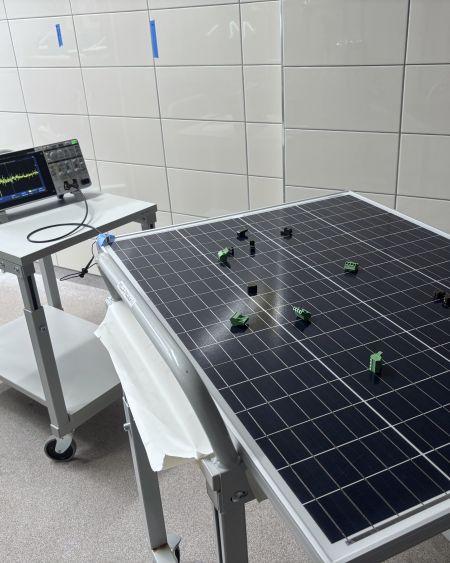
From Lego bricks to hail detection: The first step toward turning infrastructure into a smart hail sensor.
Add new comment