Enabling dew point measurement in hazardous locations - a Vaisala interview

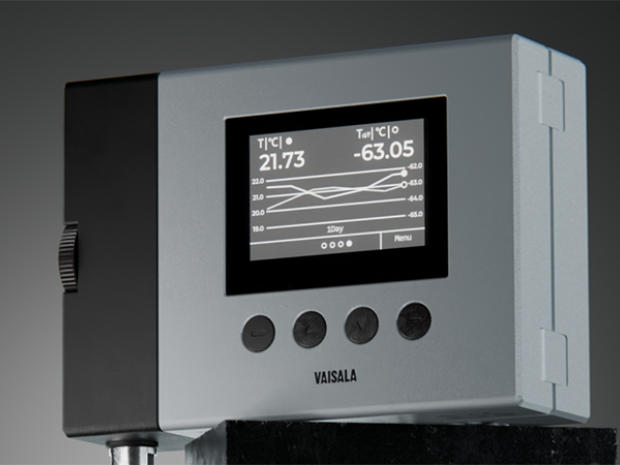
The newly launched Vaisala DMP370 intrinsically safe dew point instrument is designed to help can keep moisture out of the places where it could wreak serious and even dangerous damage in moments. Designed for easy installation, integration and operation, the DMP370 measures dew point at hydrogen production sites, natural gas infrastructure, biomethane plants, and even carbon capture facilities.
The Vaisala blog team recently spoke with Vaisala’s Product Line Manager for Industrial Decarbonization, Mr. Antti Heikkilä to discover how Vaisala is pushing moisture measurement in explosive hazard areas forward.
Question: Could you open up the DMP370 for dew point measurement a bit, what does it really enable?
Antti Heikkilä: "It's a new type of dew point transmitter for flammable gases. It brings a new level of stability, reliability, and speed of response to trace moisture measurement in e.g. hydrogen, natural gas, biomethane and power-to-gas processes."
Q: And why is Vaisala doing this now, or, only now? After all, we have been measuring dew point for a long time.
A.H.: "Previously, dew point measurement with material based sensors has either been prone to drift or it has required periodic purging/heating, which is incompatible with intrinsic safety. We are now compensating for drift with a new, intrinsically safe approach."
Q: Let's chat a bit about that. What is different, in the new drift-correction mechanism? And what does it do for you in the short and long run?
A.H.: "The traditional approach involved heating the sensor element to release adsorbed moisture to get a reference signal. Especially in Hydrogen, which conducts heat really well, this is not so easy. The heating cycle also interrupts the measurement, which can be a problem.
The new mechanism allows us to compensate for changes in the sensor without heating and hence without any interruptions to the measurement. The user benefits from continuous real-time measurement and the simplicity of an intrinsically safe, loop powered 2-wire device. "
Q: Another key point is that the DMP370 has up 20x faster response times - what is that based on?
A.H.: "This is an inherent advantage of the DRYCAP® sensor technology over aluminum oxide sensors, and the new approach taken in the DMP370 retains this feature just like other Vaisala dew point transmitters. Besides being more responsive to both increase and decrease in moisture content, the polymer sensor is resistant to being passivated in prolonged exposure to very dry gas."
Q: So it won't go to sleep, so to say?
A.H.: "That's correct. Even under prolonged exposure to very dry conditions."
Q: Any last words?
A.H.: “The new DMP370 is based on Vaisala's proven humidity and moisture measurement technology and state-of-the-art manufacturing and calibration. It has excellent out of the box reliability and it gives the same level of accuracy in the field as in its accredited, traceable calibration certificate."
Q: Thank you.
A.H.: "Thank you."
Add new comment