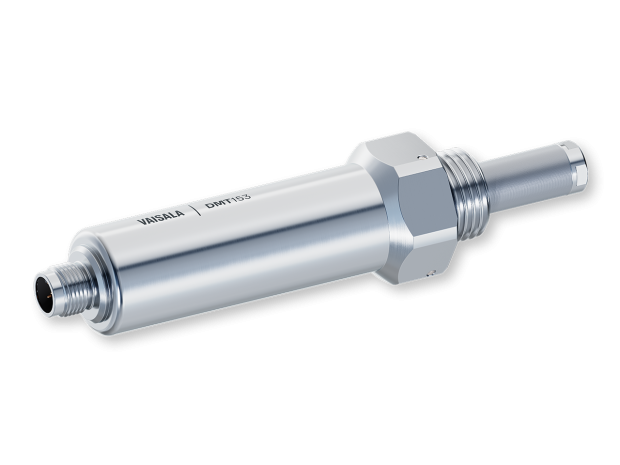
Frequently asked questions about the Vaisala Dew Point Transmitter DMT153
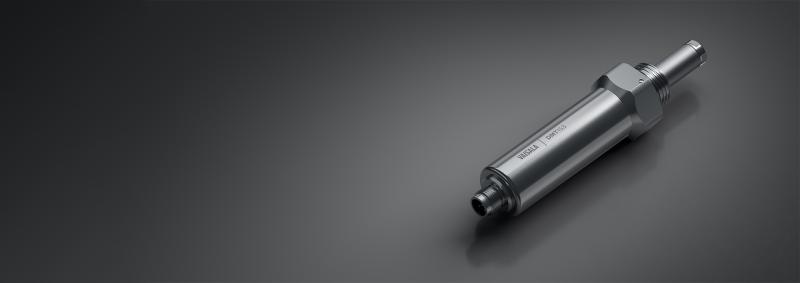

Product Manager answers
When people think about dew point measurement, they often picture a straightforward industrial application. But in reality, some of the most interesting questions come from environments where even tiny amounts of moisture can create major problems.
We hear from researchers building custom test setups, engineers running ultra-dry inert gas systems, compressed air specialists verifying air quality, and manufacturers protecting sensitive materials from oxidation or contamination. And while the applications are very different, the questions are often surprisingly similar:
- How do you install the sensor correctly?
- What happens after exposure to ambient humidity?
- Can it handle rapid pressure changes?
- How do you verify measurements without shutting down the process?
This FAQ brings together real questions we receive about the Vaisala DMT153 from demanding applications across research, aerospace, pharmaceuticals, glove boxes, compressed air, and high-purity gas systems.
If you are working with critical dry conditions, hopefully these answers make your next project a little easier.
Unique research projects
Q: Do you provide raw data access (e.g. Modbus/analog signals) that I can log into my own data acquisition system?
A: You can read dew/frost point, dew point, water concentration (ppmv/ppbv), and water mass fraction (ppmw) via analog outputs or Modbus RTU. This makes integration into lab DAQ systems straightforward.
Q: What options exist for traceable calibration, and how can I send the probe for recalibration without interrupting my experiment for too long?
A: Standard delivery includes a traceable ISO9001 calibration certificate. You can follow normal Vaisala service routes for periodic factory calibration or use field checks via Insight/Indigo80 handheld for interim verification. We also offer accredited ISO17025 calibration certificates with custom points.
Aerospace and defense
Q: Is the DMT153 qualified or commonly used in aerospace or defense applications, and are any certifications available (e.g. MIL STD, EMC/EMI)?
A: DMT153 is a robust industrial transmitter, and it complies with IEC/EN 61326 1 for industrial EMC and CISPR 11 / EN 55011 Class B. It has no explicit MIL STD qualification.
Q: How does the sensor perform under rapid temperature and pressure cycling, as in altitude or environmental stress testing?
A: The DMT153 operating temperature is −40 … +70 °C and pressure 0–50 bar absolute. The sensor is designed to withstand fluctuating temperature and pressure in real processes, not only “ideal lab” conditions, which is important in environmental test chambers and similar setups.
Specialized sensors / OEM integration
Q: Are OEM versions available?
A: Vaisala can customize and label DMT153 for OEM use depending on the customer’s needs. This requires continuous, reasonable sales volumes. Please ask for details.
Q: What power supply requirements and current consumption should we plan for in our design?
A: Operating voltage is 11–28 V DC in digital mode and 15–28 V DC when using analog outputs; typical current is about 20 mA plus load. During self-diagnostics max. 220 mA (pulsed) that the power supply must always offer.
Critical compressed air lines
Q: Can the DMT153 be used to verify compliance with ISO 8573‑1 or similar compressed air quality standards?
A: It supports monitoring of Class 1 compressed air as per ISO 8573‑1:2010
Q: How should the probe be installed (bypass line, direct insertion, sampling cell) to get representative measurements and protect the sensor?
A: Suitable locations include ducts and pipes; various sampling cells with Swagelok/VCR/quick connectors and coil options are available for bypass or 2‑pressure installations. A bypass with a small continuous flow through a sampling cell is usually preferred for high‑pressure compressed air, allowing service without venting the main line and protecting the sensor from particles.
Critical air, nitrogen, argon, helium, and other inert gas lines
Q: Does the gas pressure influence the accuracy or require any compensation?
A: Measured dew/frost point temperature does not require pressure compensation. When using ppm/ppb outputs (water concentration) or water mass-fraction, please make sure the pressure setting for DMT153 is representative of the actual measurement environment.
Q: Can it handle high‑purity gas systems without introducing contaminants (materials, outgassing, lubricants)?
A: Materials in contact with gas are stainless steel (AISI 316L, AISI 303 filter) with a stainless mesh filter, suitable for typical high‑purity lines.
Glove boxes and isolators
Q: Can the sensor be installed directly inside the glove box, or should it be used with a sampling line?
A: You can mount the probe directly through a wall with threaded fitting or use a small sampling loop if preferred (e.g. to keep electronics outside a controlled atmosphere). Typical installation is into air/gas inlet/outlets.
Q: Can the transmitter provide alarms for when the dew point exceeds a safe limit for sensitive operations?
A: When connected to an Indigo transmitter you can use local relays or additional analog channels for alarm thresholds, while in standalone mode you can use the built‑in analog channels and Modbus data to trigger alarms in your own control system.
Pharmaceutical manufacturing / APIs / lithium‑based medical devices
Q: Is the DMT153 suitable for GMP environments, and do you provide calibration certificates traceable to national standards?
A: Each unit comes with a traceable dew point calibration certificate, which supports validation and audit needs.
Q: What documentation (IQ/OQ support, calibration reports, material certificates) is available for validation and audits?
A: DMT153 complies with relevant EMC and RoHS directives. Vaisala can also provide material declaration of the product wetted parts.
Sensitive chemicals, catalysts, metal powders, oxidation/hydration‑sensitive materials
Q: Can we periodically expose the sensor to ambient humidity for checks, or will that reduce lifetime or cause drift when returning to ultra‑dry conditions?
A: Occasional exposure of the sensor to ambient humidity (for example, during installation or service) is acceptable and the sensor tolerates condensation. The purge function is specifically designed to recover performance after such events.
Q: How should we position the probe to ensure we measure representative gas conditions rather than stagnant zones?
A: Choose a point in the line or chamber where the gas is well mixed and flowing. When using a sampling cell, maintain a continuous flow (>1 l/min) so the cell is constantly refreshed and does not act as a stagnant volume. Eliminate leaks between the process and sensor.
Add new comment