Application note
Solar (photovoltaic) industry: Removal of residual sawing material from solar wafers


Introduction
Silicon crystal growing and casting plants are either an integrated unit of the photovoltaic manufacturer or independent sub-contract producers. They don’t need to be situated in the proximity of solar cell production plants because wafer transportation is inexpensive. Most are though, because the Photovoltaic manufacturers have invested to ensure a secure wafer supply to their cell plants.
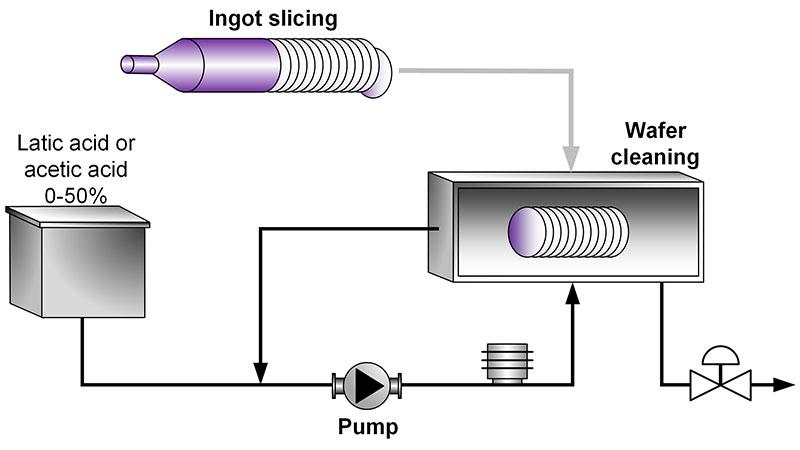
Wafer processing starts with cutting ingots into bars, then slicing them with a wire saw into wafers (slightly thicker than a compact disc). The product is then cleaned in preparation for cell manufacturing. The cleaning phase consists of an acetic or lactic acid bath, where the wafers are immersed in order to remove glue and other residues such as Si particles from the wafer surfaces.
Solar cell plants then take the cleaned wafers through a high-technology processing sequence to create the final solar product.
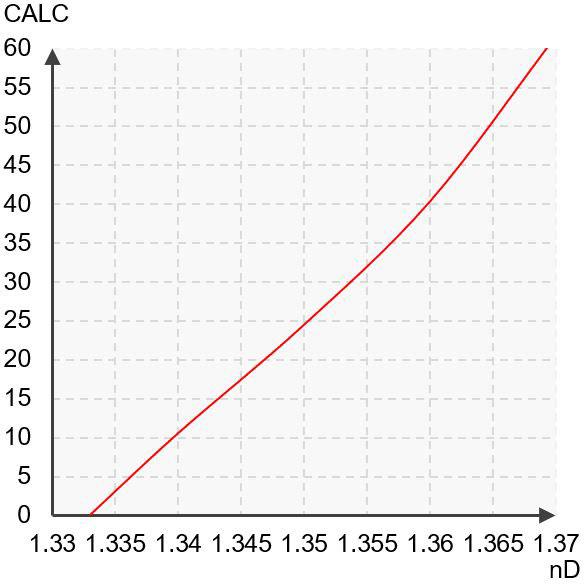
Chemical curve: Acetic acid R.I. per Conc% b.w. at Ref. Temp. of 20˚C
Application
The lactic or acetic acid bath is typically kept at a concentration between 30 % and 50 %.
Vaisala K-PATENTS® Semicon Refractometer PR33-S measures the bath concentration and helps to optimize the consumption of chemicals, and also to determine the exact timing for bath replenishment. Subsequently, an important task is to be able to control the concentration of the bath chemistry. As the chemical calibration curve (on the left) shows, the correlation of refractive index versus concentration of the used chemical (acetic acid or lactic acid) is linear.
The typical process temperature is 20-40 °C (68- 104°F) and it is also measured with the PR-33-S. Automatic temperature compensation is crucial for the concentration measurement, as refractive index is dependent on the process fluid temperature.
Typical end products
Acetic acid (CH3COOH), lactic acid (CH3CHOHCOOH):
- Solar wafers, solar cells.

Instrumentation and installation
The Semiconductor Refractometer PR-33-S is installed in the re-circulation loop of the acid bath. Our data logging software via Ethernet allows realtime collection and printing of the concentration and temperature values and sensor diagnostic data.
The sensor output signal is used to establish the optimum level of acid concentration and to trigger the spiking of the fresh chemical.

Vaisala K-PATENTS® Semicon Refractometer PR-33-S
A small footprint, PVDF covered sensor for cleanroom environment and integrated process tools. Monitors the chemical concentrations in real-time and provides an Ethernet output signal and immediate feedback to the control system. Connected through a modified PTFE flow cell body to the process by a 1/4”-1” Nippon pillar or flare fitting.
Measurement range
Refractive Index (nD) 1.3200 – 1.5300, corresponding to 0-100 % by weight.