Application note
Semiconductor wet chemicals: Bulk chemical delivery system


Introduction
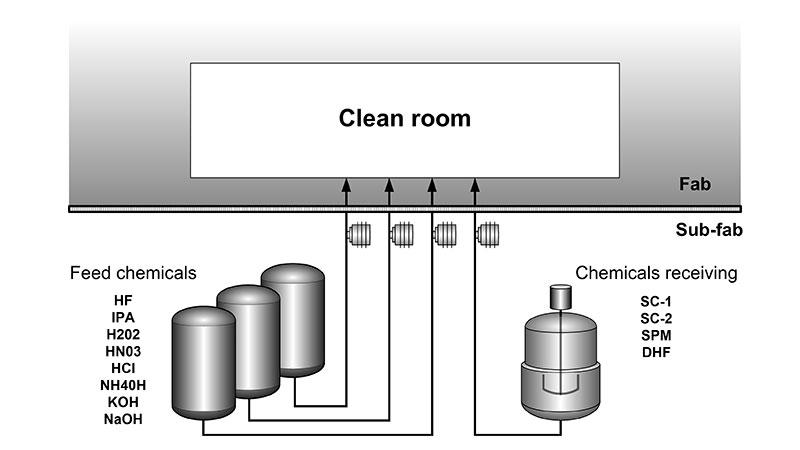
Typically, the chemical suppliers are responsible for the quality of the incoming chemicals. This leaves the semiconductor fabricators with a very limited capability to detect problems with the process chemicals that they receive from their suppliers. Poor chemical quality is revealed through production line test data or poor e-sort performance. Changes, which can occur during their handling on-site are disregarded and not monitored. Furthermore, factors such as human error in container handling and equipment failure at the distribution point are not taken into account.
Implementation of Vaisala K-PATENTS® Semicon Refractometer is economically feasible (costing less than the labor requirement for correcting a major mishap). It should also be noted, that expertise in the chemical distribution area should not be overlooked or underestimated. Instead this should be treated as a critical tool set, capable of making a significant impact on the fab very quickly.
Application
The refractometer prevents the application of incorrect bulk chemicals and concentrations into the process. This way it helps to prevent expensive equipment damage and wafer scrap. The key control function in this application is to provide an alarm as the chemical approaches its out-of-specification limit. In many cases, the cost of the refractometer can be recovered with the prevention of a single mishap.
The refractometer uses refractive index nD as a measurement principle. The benefit is that one refractometer can detect all chemicals, as every chemical is unique in terms of its physical properties, including its refractive Index value.
The standard refractometer covers the full refractive index nD range of 1.32 to 1.53 (corresponding to 0-100 % Conc.). This refractive index range can be extended by using Sapphire H74, YAG or GGG as prism material.
Typical end products
- Silicon wafers for semiconductors and microelectronics.


Instrumentation and installation
The refractometer measures the concentration of process liquids such as KOH (Potassium hydroxide), H2SO4 (Sulfuric acid), HF (Hydrofluoric acid), NH4OH (Ammonium hydroxide), HCl (Hydrochloric acid), IPA (Isopropyl alcohol), Ethylene glycol and others. It also measures such chemical mixtures as SC-1, SC-2, SPM, DHF, etc. In multi-component solutions this is a checksum; if one of the components is wrong, the overall Refractive Index changes. The only chemical parameter, which is not detectable via refractive index nD is surfactant concentration because its concentrations are only at few part per million (ppm).
Depending on the brand and chemical distribution system, an ideal location and positioning for the refractometer will allow the monitoring of chemical feed to the fab as well as drum changes.
The refractometer provides a continuous 4-20 mA or Ethernet measurement signal. Shutdown set points are determined by the incoming chemical quality. Set points for the shutdown are set according to the tolerance range for the particular chemicals. For example, if the range of assay for sulfuric acid is 95 % to 98 %, the limits for the refractive index system can be 95.5 % to 97.5 %.
A distribution system shutdown takes place as the tolerance limit is approached, preventing violation, which is very similar to how a statistical process control program would function.

Vaisala K-PATENTS® Semicon Refractometer PR-33-S
A small footprint, PVDF covered sensor for cleanroom environment and integrated process tools. Monitors the chemical concentrations in real-time and provides an Ethernet output signal and immediate feedback to the control system. Connected through a modified PTFE flow cell body to the process by a 1/4”-1” Nippon pillar or flare fitting.
Measurement range
Refractive Index (nD) 1.3200 – 1.5300, corresponding to 0-100 % by weight.