Application note
KOH etch of silicon


Introduction
Wet etching is used to chemically remove layers (metal, silicon, photoresist) from the surface of a wafer during manufacturing. Etchants that erode the substrate equally in all directions are called isotropic. Modern processes prefer anisotropic etches because they produce sharp, well-controlled features. Several anisotropic wet etchants are available for silicon. For instance, potassium hydroxide (KOH) is commonly used for this purpose, especially in the MEMS processing.
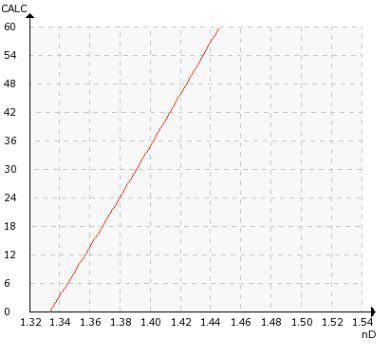
Chemical curve: KOH R.I. per Conc. % b.w. at Ref. Temp. of 20˚C
Application
The etch rate of silicon in a KOH bath depends on the bath temperature and the KOH concentration. As etching progresses, some KOH (namely OH- ions) is consumed in the process.
Vaisala K-PATENTS® Semicon Refractometer gives a real time indication of KOH concentration and helps to determine the correct etch end-point. This way the bath life can be sustained for much longer, and wafer scrap and chemical waste can be minimized. In certain cases, it is possible to double the KOH bath life.
Typical end products
Potassium hydroxide, KOH:
- Silicon wafers for semiconductors and microelectronics,
- MEMS (microelectromechanical systems),
- micromachines etc.

Instrumentation and installation
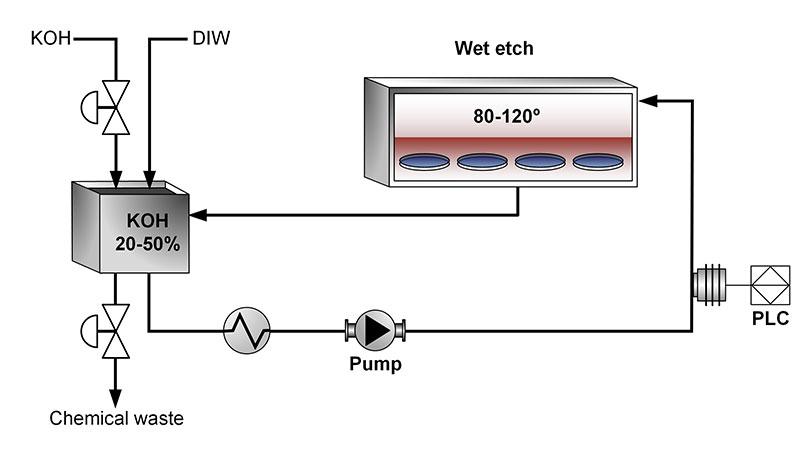
The refractometer is installed inside an etch cabinet on a circulation line, prior to the etch bath and directly after a pump. Typical KOH concentration is 30-50 % and the process temperature is 80-120 °C (176- 248 °F). The temperature can be as high as 160 °C (320°F) for heated KOH etching. The sensor can be installed into a vertical or a horizontal pipeline. The sensor should be mounted in the horizontal axis position. We recommend a minimum flow velocity of 1.5 m/s (5 ft/s).
Compensation of Silicate
Refractive index gives an indication of total dissolved solids. The etching of silicon using a KOH water mix forms a tertiary solution with the dissolved Silicate. The influence of Silicate needs to be compensated from the KOH concentration reading. We provide a method (patent pending) for compensating this in the refractometer output reading.
Dissolved Silicate increases the concentration reading. This offset can be compensated with our simple balance calculation and without introducing any extra measurements.
The amount of potassium (K+) does not change. The only two variables that change are:
- the amount of water (which may change due to evaporation and in the reaction),
- and the amount of silicon (which depends on the wafer design and etch depth). The amount of silicon can be estimated when the number and type of wafers etched in the solution are known.
The compensation factor can be implemented in the control system. The same phenomenon is seen when etching Silicon nitride with heated KOH.

Vaisala Polaris™ PR53M Process Refractometer
Description
The Vaisala Polaris PR53M PTFE-Body Process Refractometer is for chemically aggressive solutions and ultra-pure fine chemical processes. The PR53M can be mounted to ½ inch process lines with a standard NTP-threaded connection, or optional pillar or flare fittings.
Measurement range
Refractive Index (nD) 1.3200 – 1.5300, corresponding to 0-100 % by weight