Application note
Chemical interface detection in wafer cleaning


Introduction
Cleaning chemicals are the most consumed liquids in a fab. These include acids and bases to remove organic and inorganic contaminant residues from the wafers. The most commonly used cleaning solutions are standard clean 1 (SC-1) and standard clean 2 (SC-2). If the wafers are particularly contaminated, there are additional cleaning steps utilizing a solution known as Caros or Piranha and diluted hydrofluoric acid (DHF).
Thorough rinsing with deionized water (DIW) is required after each chemical step. This is usually followed by a spin dry process.
Common tools for wafer cleaning are immersion baths and single wafer spray systems. Centrifugal spray units offer benefits over immersion baths since each wafer is uniformly exposed to uncontaminated, fresh chemicals.
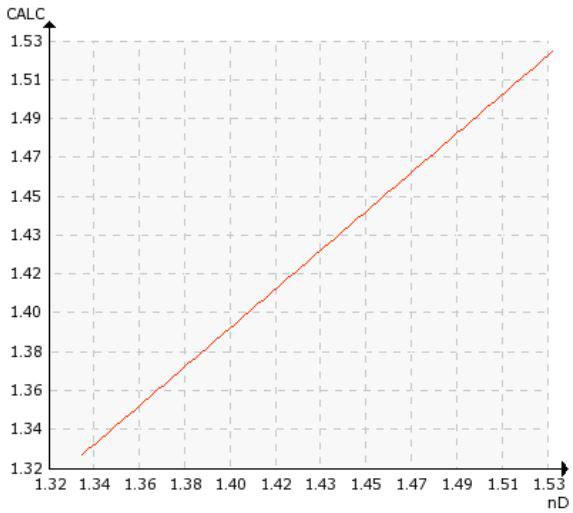
Chemical curve: R.I. per Conc% b.w. at Ref. Temp. of 20˚C
Application
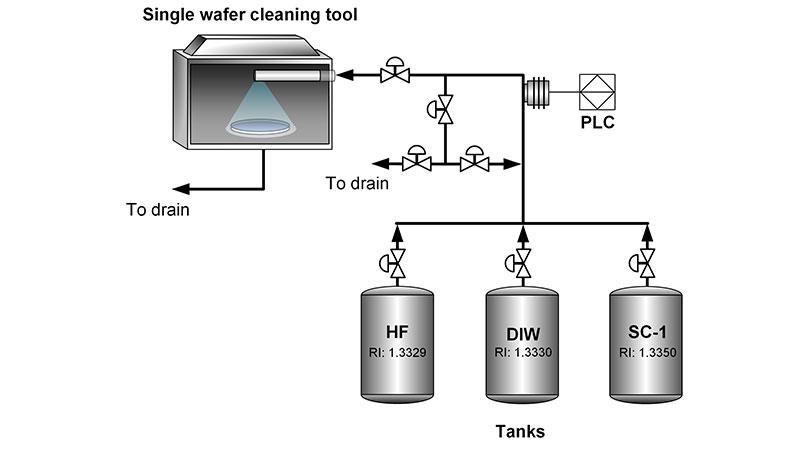
The spray acid chamber is designed to allow multiple chemicals to be applied on the wafer in-situ through a nozzle or dispenser, providing tight control while eliminating the risk of contamination.
HF and SC-1 are common chemicals used for wafer cleaning. The chemicals are delivered separately with a DIW rinse between steps. These solutions are provided at certain preferred temperatures, in a particular sequence and manner. The time span for each step is only tens of seconds.
In order to maintain a continuous flow, the interface between the liquids should be monitored. Vaisala K-PATENTS® Semicon Refractometer PR-33-S allows for instant switching between cleaning chemicals and DIW by means of refractive index measurement (Figure 1).
Refractive index is an inherent property of all liquids and is unique for each chemical. The refractometer immediately detects the liquid in the line and sends a signal to the PLC to open and close valves and divert the flow as required. This ensures the correct chemical is dispensed and prevents mixing between liquids.
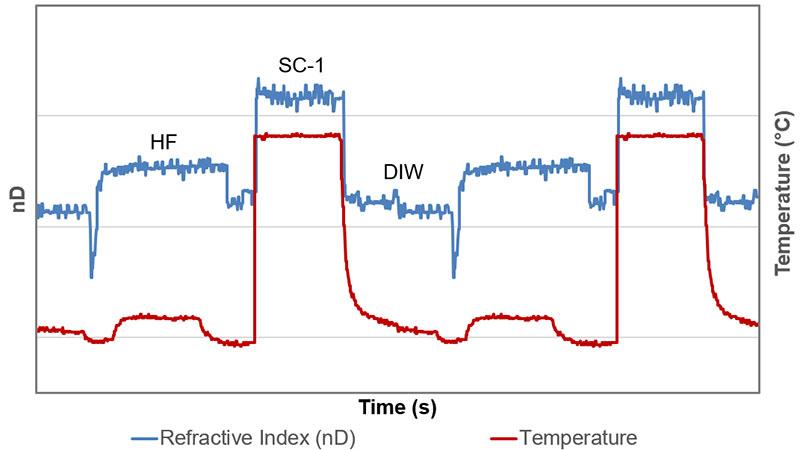
Figure 1. Example of interface detection between wafer washing steps with the refractometer.
Typical end products
Hydrofluoric acid (HF), deionized water (DIW), SC-1 (H2O2, NH3):
- Silicon wafers
Instrumentation and installation
The Semicon Refractometer PR-33-S is mounted as an integrated device in the cleaning tools. The refractometer provides Ethernet and 4-20 mA output signals that can be connected to the process controller for continuous and accurate control.
Set-points based on the refractive index values of the cleaning chemicals and DIW can be created to control the valves. The refractometer covers the full refractive index range nD of 1.32 to 1.53, with a measurement accuracy of nD ± 0.0002.
Moreover, the refractometer has a built-in temperature sensor to measure the temperature of the surface in contact with the process liquid, providing fast and automatically temperature compensated reading. Typical temperature range in this application is 20-60 ºC (68-140 ºF).

Vaisala K-PATENTS® Semicon Refractometer PR-33-S
A small footprint, PVDF covered sensor for cleanroom environment and integrated process tools. Monitors the chemical concentrations in real-time and provides an Ethernet output signal and immediate feedback to the control system. Connected through a modified PTFE flow cell body to the process by a 1/4”-1” Nippon pillar or flare fitting.
Measurement range
Refractive Index (nD) 1.3200 – 1.5300, corresponding to 0-100 % by weight.