
专业文章

超越露点值:如何在工艺流程中确保高质量的干燥压缩空气

Air compressor
Juhani Lehto,产品经理
Juhani Lehto
产品经理
维萨拉
工业制造和工艺 工业测量

Ensuring dry compressed air isn't about dew-point values alone. High-quality compressed air requires three things: good measurement practice, best-practice sensor installation, and smart sensor placement. Get these factors right, and you’ll maintain product quality, protect equipment, and increase energy efficiency.

Why moisture in compressed air matters

The compressed air used in many industrial applications needs to be kept dry. This is because moisture in compressed air can cause corrosion, blocked valves, frozen lines, product contamination, and microbial growth. If compressed air isn’t dry, it can quickly move from being a clean and reliable ‘fourth utility’ into posing a quality and maintenance risk.

There are different ways to measure the dryness of compressed air, but not all methods are equal.

Relative humidity (RH), for example, tells you the percentage of water relative to what the air can hold at that temperature. However, RH changes with temperature, so it doesn’t give a meaningful indication of condensation risk in a compressed air system.

Dew point, on the other hand, tells us the exact temperature at which moisture will condense into liquid water or ice. It is pressure dependent and shows us where and when in the process there could be a risk of moisture forming in the compressed air. This makes it the ideal control variable: if the dew point is above 0°C there is a risk of condensation and corrosion in your process. The lower the dew point, the safer it is.

Typical dew-point targets by dryer type include:

  • Refrigerant dryer: ~+5°C
  • Desiccant dryer: ~-40°C or lower

How to measure dew point correctly

Because dew point is pressure dependent, compressing air makes a difference to the measurement. It is important to take this into account if you are bleeding air to the atmosphere before measuring, as the dew point at the measurement point will be different from the dew point in the process. When pressure dew point is needed, either measure at process pressure or make sure you correct the measurement carefully.

A low dew point reading isn’t helpful if the measurement doesn’t reflect your actual process conditions. 

Three simple steps to measure dew point correctly

  1. Select an instrument with the correct measuring range.
  2. Understand the pressure characteristics of the instrument. For example, some instruments on the market can’t measure at process pressure so the measurement will need to be corrected to discover the pressure dew point.
  3. Install the sensor correctly, following the manufacturer’s instructions. Do not install dew point sensors at pipe dead ends where there is no airflow.

Where to measure dew point

Sensor placement matters when measuring dew point. If you just install a sensor after the dryer and nowhere else, the measurements will only confirm that the dryer output is within parameters. It’s best to also place sensors at critical use and end-of-line points. This will reveal any leaks as well as losses from cooling and distribution.

For example, Walki Oy Valkeakoski uses a monitoring setup with sensors post-dryer and at the end of the compressed air network. This enabled real-time alerts when a dryer malfunction caused a rise in moisture levels. The system triggered an automatic alarm when the dew point in the compressed air network reached -25°C. This alarm meant Walki could respond quickly to the problem, preventing the issue from negatively impacting their production process.

Five installation essentials for accurate dew point measurement

Even the best dew point sensor will only be as accurate as the installation allows. Here is a handy checklist of five installation essentials to make sure your dew point measurements are as accurate as possible.

  • Use the right materials. Ideally choose stainless steel with a good surface finish for piping and components. Avoid hygroscopic plastics and rubber as they can absorb moisture and then desorb it into the air. PTFE is an exception for temperatures down to around -40°C, because it has very low moisture absorption compared to other plastics.
  • Ensure connections are leak tight. Dew point measurements are highly sensitive to even the smallest leaks in the system. All connections should be tight and sealed correctly – for tapered threads like NPT, PTFE tape is recommended. For straight thread connections like G½", the sealing washer provided with the instrument should be installed between the probe and the sample cell.
  • Maintain steady flow. Dew point sensors need a slight but continuous flow across the sensing element to give an accurate reading. Higher flow rates generally improve the sensor response time, but flows of 1–2 l/min are typically enough for high-quality sensors. Don’t install sensors in dead ends with no airflow and be sure to purge sample lines before measuring.
  • Avoid condensation in the sample line. The entire sampling line including valves and fittings needs to be kept above the process dew point to prevent liquid water. Use heated or trace-heated lines if needed.
  • Use the right measurement setup. Direct inline installation is fine if the airflow is adequate and the temperature is close to ambient. A sampling cell offers protection to sensors during hot gas or water spikes and allows sensor servicing under pressure.

Which is better, spot checking or continuous monitoring?

Both methods have a purpose – spot checks can help solve issues, while continuous monitoring helps prevent them.

Indigo80_Indigo 500 spot checking
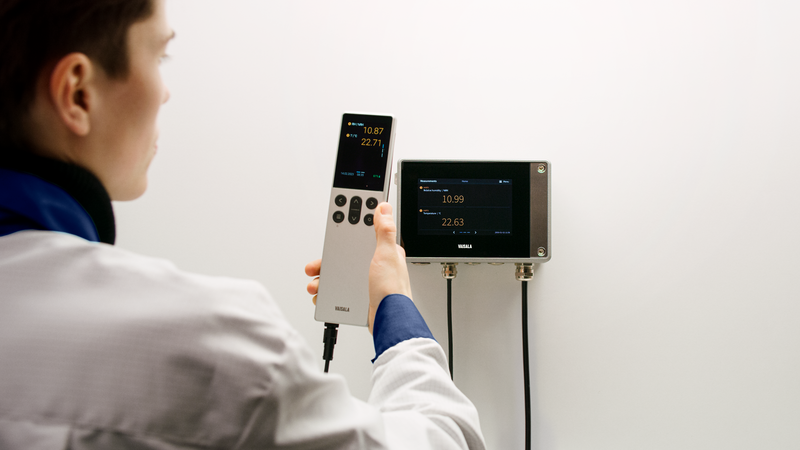
Spot checking with Vaisala Indigo80 and Indigo500


Spot checking using a portable dew-point probe and logger is ideal for performing audits, troubleshooting, and calibration checks. Energy savings can often come from finding and fixing leaks and right-sizing drying. For example, SmartAir and Energy Oy uses the Vaisala Indigo80 to generate energy and cost savings for customers that use compressed air. 

Continuous monitoring gives you real-time situational awareness and enables automatic alarms if the dew point drifts or spikes. Drifts or spikes can be a sign of a dryer malfunction, tower switching, or a sudden load change. For example, at Walki’s Valkeakoski plant, sensors triggered an alarm when the dew point climbed to –25°C. This enabled quick corrective action before the change affected product quality. Continuous monitoring also provides useful trend data that you can use for maintenance and investment planning.

What are the relevant quality frameworks for compressed air?

The main ISO standard for measuring the purity of compressed air is ISO 8573, which divides compressed-air quality into classes for particles, water, and oil. The standard covers nine areas, including contaminants and purity classes, as well as the actual test methods for a wide range of variables including oil, gases, water, and humidity. Dew point measurement is how you prove compliance with the water component of the standard.

For hygiene-critical industries where there is a microbial growth risk, ISO 8573-7 covers viable contaminants. The dryness and cleanliness of compressed air is one of the primary barriers against microbial growth.

The benefits of modern dew-point instruments

Modern dew point instruments differ significantly from older chilled-mirror hygrometers or slow capacitive probes. Vaisala’s DRYCAP® sensors have a highly sensitive thin-film polymer that provides:

  • A fast response from wet to dry and back again
  • Long-term stability and minimal recalibration needs
  • High tolerance to condensing environments
  • Immunity to contamination thanks to the automatic chemical purge function
  • Excellent accuracy with very small hysteresis
  • Fast response time with minimal drift

For engineers who need to convert between atmospheric dew point and pressure dew point or make other complex humidity calculations or conversions, Vaisala offers a free and easy-to-use humidity calculator.  

Want to find out more about compressed air and dew point measurement? Download the Compressed Air eGuide or watch The essentials with compressed air dew point webinar


确保干燥的压缩空气不仅仅关乎露点值。高质量的压缩空气离不开三要素:规范的测量实践、科学的传感器安装,以及合理的传感器放置。若能做到这些,您便能有效维持产品质量、保护设备并提升能源效率。

压缩空气中的湿度为何重要

许多工业应用中使用的压缩空气需要保持干燥。这是因为压缩空气中的湿度可能导致腐蚀、阀门堵塞、管线冻结、产品污染和微生物滋生。如果压缩空气不够干燥,它很快就会从清洁可靠的“第四大能源”变成质量和维护的隐患。

测量压缩空气干燥度有多种方法,但并非所有方法都同样可靠。

相对湿度 (RH) 就是一个例子,它表示空气中所含水分占该温度下空气所能容纳的最大水分量的百分比。然而,RH 会随温度变化,因此不能作为压缩空气系统中指示冷凝风险的有效指标。

而露点指示水分将凝结成液态水或冰的确切温度。它受气压影响,并可指示在工艺流程中可能存在压缩空气中水分凝结风险的地点和时间。这使得它成为理想的控制变量:如果露点高于 0°C,则您的工艺流程就存在冷凝和腐蚀的风险。露点越低,安全性越高。

按干燥机类型划分,典型的目标露点值如下:

  • 冷冻干燥机:约 +5°C
  • 吸附式干燥机:约 -40 °C 或更低

如何正确测量露点

由于露点随气压变化,因此压缩空气会影响测量结果。如果您在测量前将空气排放到大气中,务必应将这一点考虑在内,因为测量区域的露点将与工艺流程中的露点不同。当需要压力露点时,应在过程压力下进行测量,或确保对测量结果进行仔细修正。

如果测量结果不能反映您的实际工艺条件,那么即使是低露点读数也没有意义。 

正确测量露点的三个简单步骤

  1. 选择具有正确测量范围的仪表。
  2. 了解仪表的气压特性。例如,市面上的某些仪表无法在过程压力下直接进行测量,因此需要对测量结果进行修正,才能得出压力露点。
  3. 按照制造商的说明正确安装传感器。切勿将露点传感器安装在没有气流的管道死角。

露点测量位置

测量露点时,传感器的安装位置至关重要。如果您只在干燥机后安装传感器,而没有在其他位置安装,那么测量结果只会确认干燥机的输出是否在参数范围内。建议您同时在关键使用点和管路末端安装传感器。这有助于发现泄漏,以及因冷却和输送过程造成的水分损失。

例如,Walki Oy Valkeakoski 配置了监测系统,将传感器分别安装在干燥机后和压缩空气网络末端。因此,当干燥机发生故障导致湿度上升时,可实现实时警报。当压缩空气网络中的露点达到 -25°C 时,系统触发了自动警报。该警报使 Walki 得以及时响应,从而避免问题对其生产过程造成不利影响。

准确测量露点的五大安装要点

即使是优质的露点传感器,其测量准确度也取决于安装方式。以下是一份实用的五项安装要点清单,可确保您的露点测量尽可能准确。

  • 选用合适的材料。理想情况下,管路和组件应选用表面光洁度良好的不锈钢。避免使用吸湿性塑料和橡胶,因为它们会吸收水分,随后又将其释放到空气中。PTFE 是一个例外——在温度低至约 -40°C 的条件下,其吸湿性远低于其他塑料,因此可以使用。
  • 确保连接处密封无泄漏。露点测量对系统中即使极其微小的泄漏也非常敏感。所有连接必须紧固并正确密封——对于锥形螺纹(如 NPT),建议使用 PTFE 胶带;对于直螺纹连接(如 G½"),应将仪表附带的密封垫圈安装在探头与采样单元之间。
  • 保持气流稳定。露点传感器需要在传感元件表面维持微小但持续的气流,才能获得准确读数。较高的流速通常可缩短传感器响应时间,但对于优质传感器而言,1-2 l/min 的流量通常已足够。切勿将传感器安装在没有气流的死角,并确保在测量前对采样管路进行吹扫。
  • 避免采样管路内产生冷凝。整个采样管路(包括阀门和接头)必须保持在工艺露点温度以上,以防止液态水形成。必要时可使用加热或伴热管路。
  • 采用正确的测量设置。若气流充足且温度接近环境温度,可直接采用在线安装方式。在高温气体或水分突增的情况下,采样单元可为传感器提供保护,并支持在带压状态下对传感器进行维护。

现场抽查和连续监测,哪个更好?

两种方法都有适用的目的——现场抽查有助于解决问题,连续监测则有助于预防问题。
Indigo80_Indigo 500 spot checking
Spot checking with Vaisala Indigo80 and Indigo500


使用便携式露点探头和记录仪进行现场抽查,是开展审计、故障排除和校准检查的理想方式。通过发现并修复泄漏、合理配置干燥设备,通常可显著节约能源。例如,SmartAir 和 Energy Oy 使用维萨拉 Indigo80 为使用压缩空气系统的客户节省了能源和成本。 

连续监测可让您实时掌握系统状况,并在露点发生漂移或突增时启用自动警报。漂移或突增可能表明干燥机出现故障、吸附塔切换或负载发生突变。例如,在 Walki 位于瓦尔凯阿科斯基的工厂,当露点上升至 -25°C 时,传感器触发了警报,使工作人员能够在产品质量受到影响之前迅速采取纠正措施。连续监测还能提供有价值的趋势数据,可用于维护安排和投资规划。

压缩空气的相关质量标准体系有哪些?

用于衡量压缩空气纯度的主要 ISO 标准是 ISO 8573,该标准将压缩空气质量划分为颗粒物、水分和油分的若干等级。该标准涵盖九大方面,包括污染物类型与纯度等级,以及针对油分、气体、水分和湿度等多种参数的具体测试方法。其中,露点测量是验证是否符合该标准中水分要求的主要方式。

对于存在微生物滋生风险的卫生敏感型行业,ISO 8573-7 针对可存活污染物作出了规定。压缩空气的干燥度和洁净度,是防止微生物滋生的关键屏障之一。

维萨拉露点仪表的优点

维萨拉 DRYCAP® 传感器采用高灵敏度的薄膜聚合物,具备以下优点:

  • 无论从潮湿到干燥,还是从干燥到潮湿,均能迅速响应
  • 长期稳定性强,几乎无需频繁重新校准
  • 对冷凝环境具有良好耐受性
  • 具备自动化学吹扫功能,可有效抵御污染
  • 准确度良好,滞后小
  • 响应速度快,漂移低

对于需要在大气露点与压力露点之间进行转换,或执行其他复杂湿度计算或转换的工程师,维萨拉提供了一款免费且易于使用的湿度计算器。 

想要了解更多关于压缩空气和露点测量的信息吗?请下载压缩空气干燥电子指南,或观看 “压缩空气露点的基本知识”网络研讨会。 


露点测量的实用清单

✔  选择正确的测量点位,例如干燥机后和使用点

✔  在正确的过程压力下测量,或对测量结果进行适当修正

✔  使用不锈钢采样管路和采样单元

✔  确保接头密封无泄漏

✔  保持传感器表面有微小而稳定的气流

✔  避免安装在死角,并在测量前对采样管路进行吹扫

✔  保持采样管路温度高于露点温度——必要时可使用伴热管路

✔  明确何时仅需现场抽查,何时必须进行连续监测

 

Juhani Lehto
Juhani Lehto
高端产品经理
维萨拉
E-mail Facebook Twitter LinkedIn