Advancing climate-smart agriculture with accurate greenhouse gas measurements


The client:
Datasense Oy
Vaisala solution:
CARBOCAP® Carbon Dioxide Probe GMP343
Weather Transmitter WXT530
Datasense is an innovative company in environmental monitoring, offering cutting-edge solutions and data services that challenge the status quo. By providing advanced tools for environmental guardianship, Datasense ensures a sustainable future for all, driving innovation and excellence in the field.
THE CHALLENGE: Help farmers understand the climate impact of their agricultural fields
Peatland cultivation refers to the agricultural use of peatlands — wetland areas with thick layers of accumulated organic matter. A common practice in several areas of the world, this involves draining the wetlands to cultivate crops. The process also leads to environmental challenges including carbon emissions.
To address the challenge of carbon emissions, food production companies are looking to develop farming techniques, plant selections and cultivation methods that promote carbon neutrality. This involves measuring greenhouse gas emissions to understand the effects of different cultivation methods on these emissions.
Datasense developed their GHG Research Suite to help their customers study the climate impacts of peatland cultivation. Using innovative chamber and eddy covariance measurement systems, the long-term data series helps them to identify what type of cultivation vegetation most effectively sequesters carbon dioxide, and what cultivation methods reduce greenhouse gas emissions.
"We chose Vaisala’s GMP343 sensors and WXT530 transmitters for their reliability and accuracy. The GMP343 provides precise CO₂ measurements even in harsh conditions, essential for studying the climate impact of peatland cultivation. The WXT530 offers key weather data, helping us understand the carbon cycles.”
Jari Hakkarainen
CEO, Datasense
THE APPROACH: Trusted measurement accuracy for reliable results
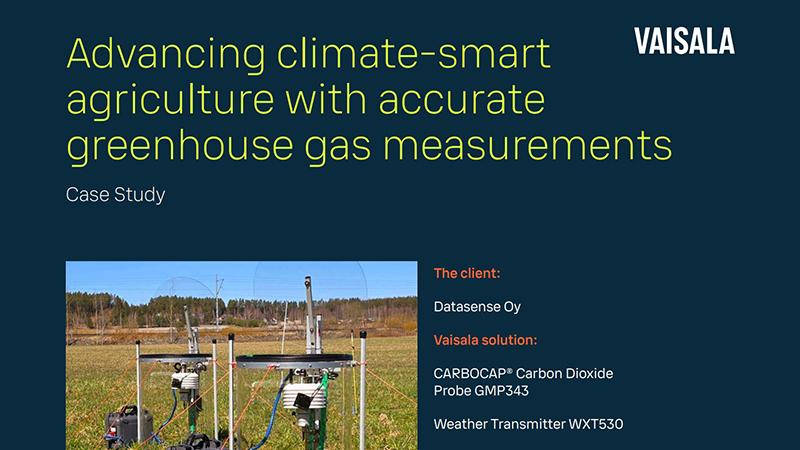
Datasense chose the Vaisala CARBOCAP Carbon Dioxide Probe GMP343 sensor for their automatic chamber measurement system, and the Vaisala Weather Transmitter WXT530 for their eddy covariance flux measurement system. Each instrument provides critical measurements that serve a unique purpose.
The GMP343 sensor measures soil respiration and the effect of plant photosynthesis on greenhouse gas emissions in automatic chamber systems. Datasense selected GMP343 for its durability in harsh conditions, thanks to a built-in optics heating system that keeps it condensation-free in high humidity inside the chambers. Its exceptionally accurate carbon dioxide measurement is essential for studying the climate impacts of peatland cultivation.
The WXT530 transmitter serves as a weather station in the eddy covariance flux measurement system, providing key parameters like rainfall, air temperature, humidity and pressure. Researchers use this data to calculate the carbon cycle of the field ecosystem, helping them understand how much carbon has been released into the atmosphere or sequestered by different plants. The wind speed and direction data are also useful for assessing the optimal timing for spraying plant protection products.
THE RESULTS: Better cultivation methods for sustainable peatland farming
The information gathered through these studies is helping farmers understand the climatic effects of cultivating peatlands and how various cultivation techniques can decrease greenhouse gas discharges. It is shedding light on how carbon moves through a field’s ecosystem and how much carbon dioxide is released — critical for adapting farming methods that are good for the environment.
This data-based approach to selecting cultivation methods, plant varieties and soil enhancements that reduce emissions empowers modern farmers with a sustainable approach that will stand the test of time.
Image: Datasense Oy