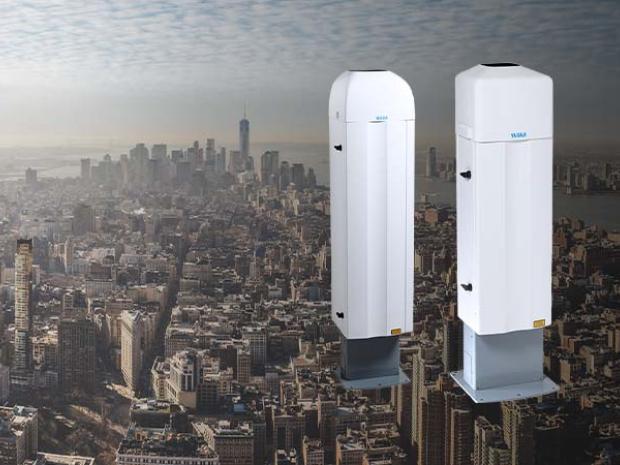
Achieving new heights



The client: The U.S. Environmental Protection Agency
Vaisala solution: Ceilometer CL51
The U.S. Environmental Protection Agency (EPA) has one mission: Protect human health and the environment. This takes many forms at national and state levels, and air quality is one of the highest priorities.
The EPA has created national and regional rules to reduce emissions of pollutants that form ground-level ozone, and develops measurements and methods to help states, tribes and air quality managers accurately monitor air pollutants.
The organization requires states to participate in the Photochemical Assessment Monitoring Stations (PAMS) network, the purpose of which is to measure ozone precursors in cities with at least one million residents. Ozone precursors react with other compounds in a photochemical process to create ground-level ozone, which is harmful to breathe. Monitoring ozone helps agencies to observe air quality trends, provide public health alerts and assess standards compliance.
Individual PAMS sites are operated by local agencies, and the network is being used to form a database of ozone precursors and meteorological measurements that support ozone model development and track concentration trends.
THE CHALLENGE: Obtaining mixing layer height measurements
Ozone precursors are primarily found in the boundary layer or mixing layer of the atmosphere, where air from the surface blends with air higher aloft. EPA requirements call for accurate detection of the mixing layer height, which is key for determining the volume of the air available for pollutant dilution and forecasting ozone formation.
Several technologies exist for measuring mixing layer height, including ceilometers. The right instrument would have to provide highly accurate measurements around the clock. Cost efficiency and ease of deployment are also priorities — especially in cities where more than one device will be used.
THE APPROACH: Securing accuracy and reliability with ceilometers
After careful evaluation, the EPA found that the Vaisala CL51 Ceilometer meets all of their requirements for measuring MLH and more. The CL51 is purpose-built to measure cloud height and mixing layer height. The fully automatic system provides a strong, stable signal over its full cloud reporting range up to 13km (43,000ft) and backscatter profiling over a full range up to 15km (49,200ft).
Detailed cloud layer data is needed to build precision simulations of existing conditions. The CL51 provides this in a compact, affordable, turnkey design that is easy to set up and requires almost no maintenance. Self-diagnostics include contamination monitoring and status reporting, while autocalibration simulates a delayed return of a laser firing to test operating range, which is critical for accurate MLH measurements.
The included BL-View software logs and displays real-time data, and automatically fulfills the PAMS requirement of calculating the hourly average mixing height. Up to 10 ceilometers can be connected to BL-View for a centralized view of the data.
THE RESULTS: Gaining deeper understanding and new insights
The CL51 Ceilometer is gaining rapid acceptance across the US for its accurate and dependable measurements. Agencies are using the ceilometers for many purposes including model assimilation and verification, daily forecasting, and data analysis for understanding and characterization.
The device is also being used for unique purposes such as tracking wildfire smoke as well as studying smoke plume dynamics and the chemistry of prescribed burns.
Automated data collection helps agencies track mixing layer height levels over time which will help them measure the impact of pollution reduction methods. As more mixing layer height is measured and tracked throughout the country, cities and the EPA are gaining greater situational awareness and actionable information that can be used to target the most efficient and effective air pollution mitigation methods.